
Main Story Flow
The StandMajor events ordered chronologically by story time.
increasing Bearing strength in each event
 decreasing
Bearing strength in each eventdecreasingProject Blue accident
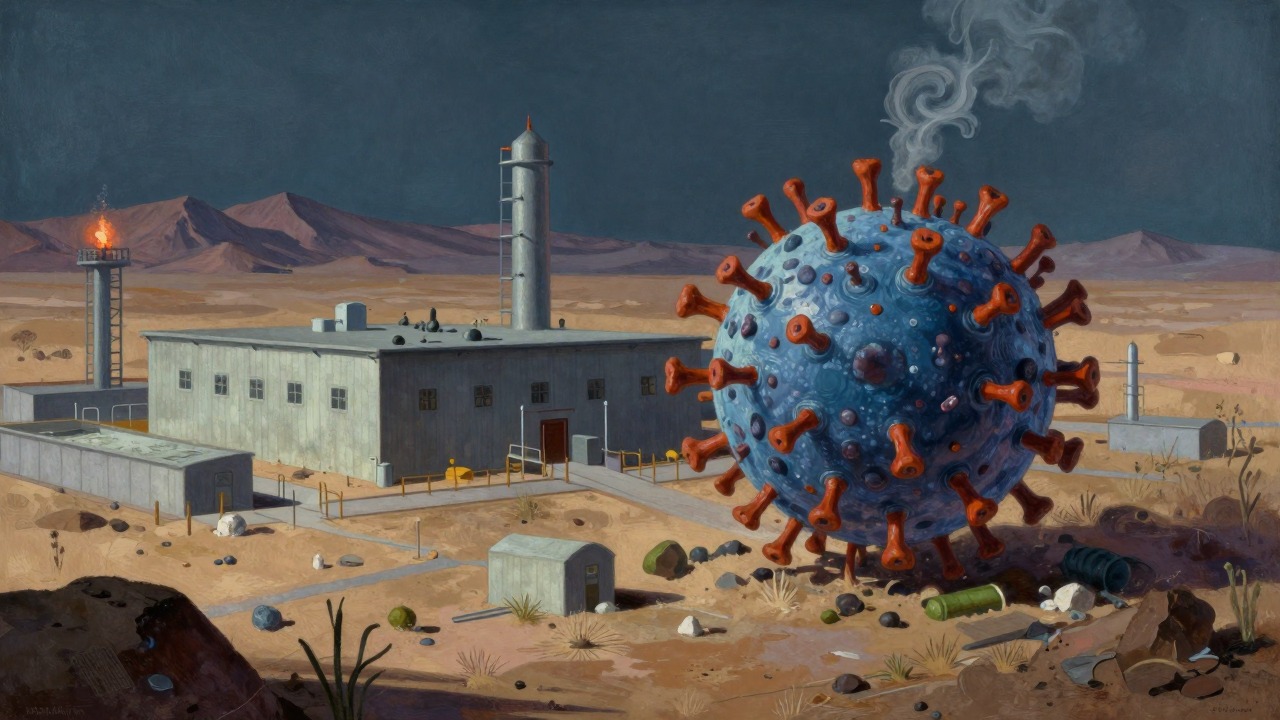
The Project Blue accident is the originating catastrophe of the novel, a containment failure at a clandestine U.S. biological weapons facility buried under the California desert. The facility was developing a weaponized influenza virus, coded 848-AB, engineered with a shifting-antigen mechanism that made it almost universally lethal and impossible to vaccinate against. The accident occurred when a technician's error and a security-system malfunction allowed the virus to escape, killing nearly everyone at the facility and then spreading across the continent through an unwitting chain of infected travelers.
Causes and Background
Project Blue was a top-secret government program, subsidized by taxpayer money, that had created a virus with a 99.4% estimated excess mortality and communicability rate. The virus was designed to mutate constantly, so that every time a victim's body produced antibodies, the pathogen shifted to a slightly new form, making recovery impossible. The accident was triggered by a chain of coincidences and incompetence. A "sniffer" box—a safety device assembled by female technicians who did not know what they were building—was defective. A security guard, Charles Campion, was on duty in a tower when the monitoring clock turned from green to red, indicating a breach. The facility's fail-safe system was supposed to mag-lock all doors the instant the clock went red, but a forty-second lag allowed Campion to escape the tower before it sealed. He then drove through the main gate just four minutes before the base was fully locked down. No one started looking for him for nearly an hour because there were no monitors in the security posts, and everyone assumed he was still inside waiting for the "sniffers" to sort clean areas from dirty ones.
The Breach and Initial Spread
Campion, already infected, fled with his wife Sally and their baby daughter LaVon. He drove east using ranch trails, and by the time the military realized he had escaped, he had reached Texas. On June 16, 1990, Campion crashed his Chevrolet into the gas pumps at Bill Hapscomb's Texaco station in Arnette, Texas. He was taken to a hospital but died en route. His wife and daughter were already dead in the car. The men who handled Campion and his family—including Stu Redman, Vic Palfrey, and Bill Hapscomb—were immediately exposed. The virus spread from Arnette through a chain-letter effect. Texas Highway Patrolman Joe Bob Brentwood, who visited the station the next morning, was infected and passed the disease to over forty people during his patrol. One of those, insurance man Harry Trent, infected dozens more at a café called Babe's Kwik-Eat, including a New York police lieutenant named Edward Norris and his family, who then carried the virus across the country. The military attempted to contain the outbreak by quarantining Arnette with barbed wire and roadblocks, but the virus had already escaped into the general population.
Government Response and Cover-Up
The military, under the command of General Starkey and later Len Creighton, initiated Operation Carnival, a massive cover-up. They quarantined towns, blocked highways, and managed the news, claiming the outbreak was a minor flu epidemic for which a vaccine would soon be available. When reporters in Sipe Springs, Texas, tried to expose the truth, Starkey ordered a "Troy"—a covert countermeasure that resulted in the reporters being murdered by soldiers. The cover-up unraveled as the pandemic overwhelmed the country. WBZ-TV in Boston was briefly seized by newscasters who broadcast the truth before the transmitter was destroyed. The Los Angeles Times managed to print 10,000 copies of an extra edition exposing the government's lies before its presses were dynamited. By late June, the social order had collapsed, with mass riots, executions, and the formation of breakaway republics. The President gave a speech denying the severity of the outbreak, but by then the pandemic was unstoppable.
Consequences and Aftermath
The Project Blue accident directly caused the death of over 99% of the world's population. The virus, known colloquially as Captain Trips, spread globally within weeks. The few survivors, who were naturally immune, were left to rebuild society. The accident also created the central conflict of the novel: the struggle between the forces of good, coalescing around Mother Abagail in the Boulder Free Zone, and the forces of evil, coalescing around Randall Flagg in Las Vegas. The Free Zone Committee, formed by survivors, explicitly recognized that the plague was not an act of God but an "act of pure human fuckery"—a man-made disaster born of secret government programs. The novel's resolution, in which a nuclear warhead is detonated in Las Vegas, can be seen as a final, ironic consequence of the same military-industrial complex that created the plague. The accident is the foundational event that empties the world and forces the remaining characters to make a stand between the opposing principles of creation and destruction.
Captain Trips pandemic
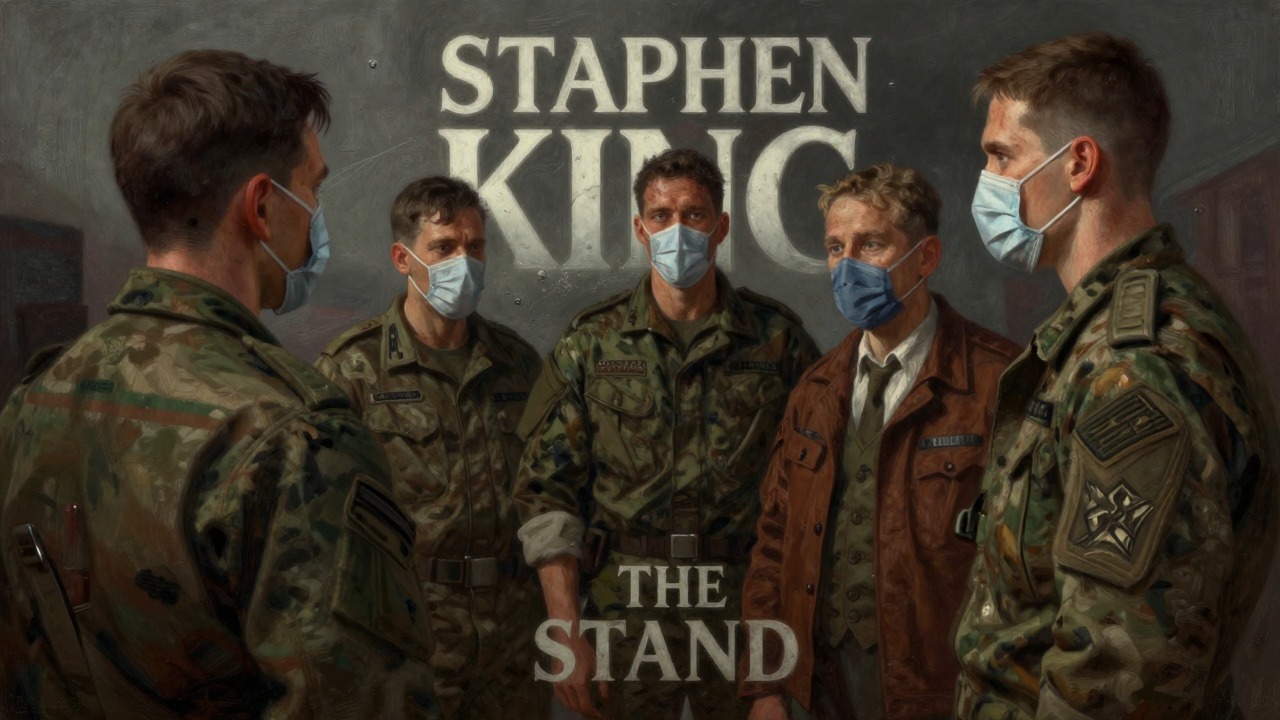
Captain Trips pandemic, also called the superflu or A-Prime flu, is the engineered viral outbreak that kills 99.4% of the world's population in Stephen King's The Stand, setting the stage for the apocalyptic confrontation between the forces of good and evil. Accidentally released from a U.S. military biological warfare facility called Project Blue, the constantly mutating virus spreads with devastating speed, collapsing civilization within weeks and leaving only a handful of immune survivors to choose sides between Mother Abagail's Boulder Free Zone and Randall Flagg's Las Vegas empire.
Origins and Release
The superflu was created at Project Blue, a secret biological weapons installation under the California desert. The virus was coded 848-AB and described as a "constantly shifting A-Prime flu" with an estimated 99.4% communicability and excess mortality rate. On June 13, 1990, a technical slip-up allowed the containment to be breached. Army security guard Charles Campion, on duty at the Number Four security post, saw the monitoring clock turn red and escaped through the mag-locked doors just before the base sealed itself. He fled with his wife Sally and daughter Baby LaVon, driving east through ranch trails before the sirens began. By the time the military realized Campion had escaped, he had already reached Texas, carrying the infection inside him.
Transmission and Spread
The virus spread through a lethal chain-letter mechanism. Campion crashed his Chevrolet into Bill Hapscomb's Texaco station in Arnette, Texas, infecting the men who came to help. From there, Texas highway patrolman Joe Bob Brentwood carried it to dozens more during his patrol. Harry Trent, an insurance man Brentwood ticketed, passed it to over forty people in a single day, including a New York police lieutenant named Edward Norris and his family at a café called Babe's Kwik-Eat. The Norris family then spread it across multiple states as they traveled home. The pyramid built from the tip down, with each infected person passing the disease to five more, then those five to twenty-five, and so on. Within weeks, the virus had appeared in Oregon, Nebraska, Louisiana, Florida, and tentatively in Mexico and Chile.
Symptoms and Lethality
The superflu presented with symptoms indistinguishable from a common cold or flu: chills, fever, headache, weakness, loss of appetite, painful urination, and swelling of the glands. The disease progressed through four stages, though some patients skipped stages or backtracked. The key to its deadliness was its shifting-antigen mechanism: every time the human body produced antibodies to fight one strain, the virus mutated into a slightly new form, making vaccine development nearly impossible. In the final stage, victims' necks swelled to a purple-black color, their respiration became labored, and they choked to death on their own mucus or were burned alive by fever. The mortality rate was effectively 99.4%.
Government Response and Cover-Up
The U.S. government attempted to contain both the disease and the truth. Towns like Arnette were quarantined with barbed wire and armed sentries. The Atlanta Plague Center was breached, forcing a move to the Stovington Plague Control Center in Vermont. General Starkey, the Project Blue commander, ordered the "Troy" protocol to suppress news of the outbreak, resulting in the murder of reporters and photographers in Sipe Springs, Texas. The military took over television stations, forcing anchors to read false copy about a soon-to-be-available vaccine. WBZ-TV in Boston was briefly liberated by its staff, who broadcast footage of bodies being dumped into Boston Harbor with pitchforks, before the transmitter was destroyed with plastique. The Los Angeles Times managed to print 10,000 copies of an extra edition exposing the cover-up before its presses were dynamited. The President delivered a speech denying the severity of the outbreak, but his address was repeatedly interrupted by coughing fits.
Collapse of Society
By late June, the social order had disintegrated. In New York City, the smell of rotting corpses filled the streets. Power failed in most areas. The Lincoln Tunnel was blocked by army trucks and bodies. In Boston, a black "junta" performed public executions on live television. At Kent State University, soldiers opened fire on student demonstrators, killing dozens. In San Francisco, a sergeant proclaimed himself President of the Republic of Northern California before being shot. The army itself was decimated by the disease, with desertion rates soaring and soldiers sometimes turning on their own officers. By July, the pandemic had burned itself out, leaving only a tiny fraction of humanity alive.
Aftermath and Legacy
The superflu's aftermath created a world where the remaining survivors were forced to rebuild from scratch. The virus's shifting-antigen nature meant that even the immune survivors faced uncertainty about whether their children would survive. The first baby born to immune parents after the plague, Peter Goldsmith-Redman, contracted the disease but appeared to be fighting it off, suggesting that immunity could be passed from mother to child. The pandemic's legacy was not just death but a profound transformation: it ended the old world of technology, government, and organized society, and set the stage for the final confrontation between the forces of good, represented by Mother Abagail's Boulder Free Zone, and evil, represented by Randall Flagg's Las Vegas empire.
Charles Campion's crash in Arnette
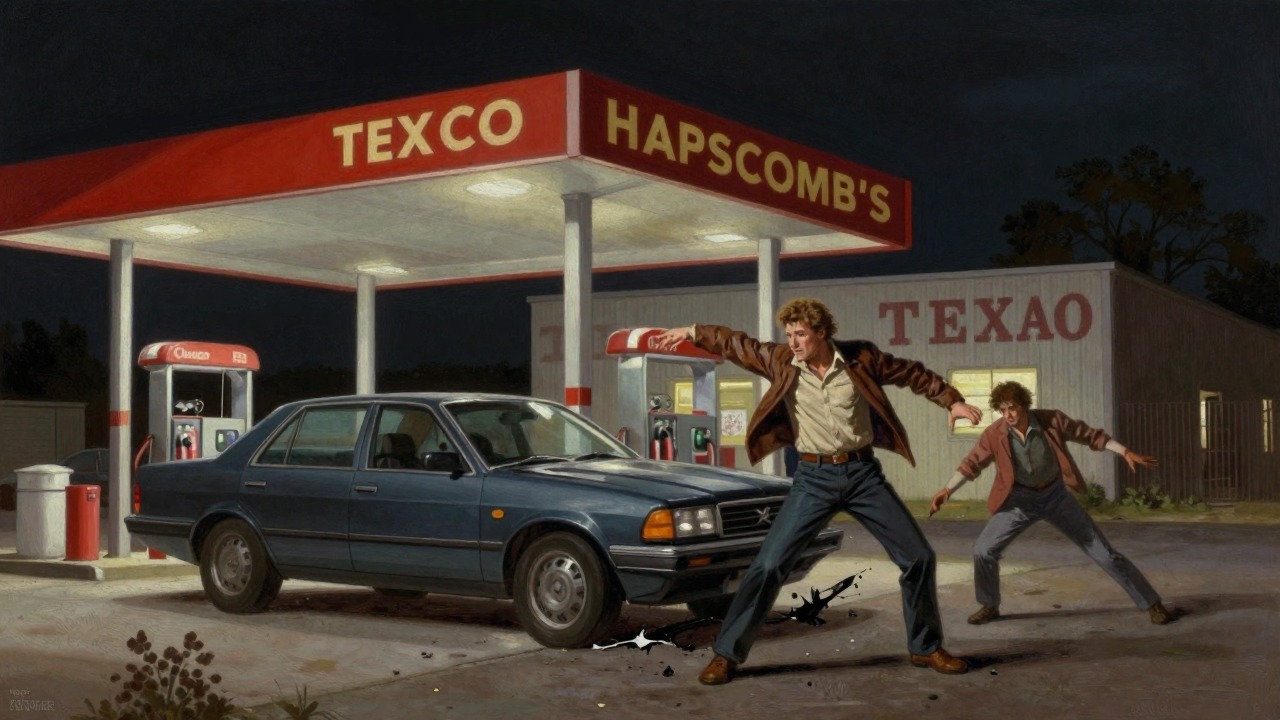
Charles Campion's crash at Hapscomb's Texaco station in Arnette, Texas, on the night of June 16, 1990, is the novel's inciting incident, the single event that unleashes the superflu pandemic upon the world. The crash is not an accident of speed or recklessness but a desperate, final act of a man already dying from a weaponized virus, making it a scene of profound, tragic consequence that transforms a quiet evening among friends into the first domino of global apocalypse.
The Crash and Its Immediate Aftermath
Campion, a security guard from the secret Project Blue facility, drives his old Chevrolet into the station at a steady fifteen miles per hour, his head lolling and striking the windshield. He plows through the pump island, shearing off the hi-test, low-lead, and regular gas pumps before coming to rest. The men inside—Bill Hapscomb, Stu Redman, Vic Palfrey, Norm Bruett, Tommy Wannamaker, and Henry Carmichael—rush out. When Hap opens the driver's door, Campion spills out like an old laundry sack, and a ghastly, sickening stench of blood, fecal matter, vomit, and human decay issues from the car. Inside, Campion's wife and young daughter, Baby LaVon, are already dead, their necks swollen to a purple-black color, their bodies covered in thick mucus. The men are immediately exposed to the disease.
The Carrier and His Burden
Campion, delirious with fever, is carried inside. He mutters about a clock that went red, a reference to the security breach at Project Blue. He asks about his wife and daughter, whom Hap falsely reassures are fine, and then dies on the way to the hospital in Braintree. His wallet identifies him as Charles D. Campion, an army security guard. The crash is the culmination of a desperate flight from the California desert, where a technical slip-up at Project Blue allowed the weaponized superflu to escape. Campion, his wife Sally, and their daughter had been trying to outrun the disease, but they were not quick enough. The crash in Arnette is the point where the contained accident becomes a national catastrophe.
The Spread of the Plague
The crash directly infects the men at the gas station, who then spread the virus to their families and the wider community. The novel meticulously traces the chain of infection from this single point: Joe Bob Brentwood, the state patrolman who visits the station, passes it to Harry Trent, an insurance man, who infects dozens more. The disease, known as Captain Trips, spreads with terrifying speed, its 99.4% communicability and mortality rate ensuring that within weeks, the vast majority of the world's population is dead. The crash is the zero point of the pandemic, the moment the carefully constructed walls of secrecy around Project Blue are breached and the plague is let loose upon an unsuspecting world.
Thematic Significance
The crash serves as a brutal, ironic inversion of the American roadside mythos. The Texaco station, a place of refuge, community, and simple hospitality, becomes a vector for death. The men who gather there to discuss hard times and the economy are about to experience a hardship beyond any they could imagine. Campion's arrival is a dark parody of a traveler seeking help; instead of needing gas or directions, he brings a biological weapon. The event underscores the novel's central theme of the fragility of civilization and the catastrophic consequences of human error and hubris, as a single, contained mistake in a secret military lab is amplified into an extinction-level event by a chain of seemingly random coincidences and failures.
Quarantine of Arnette
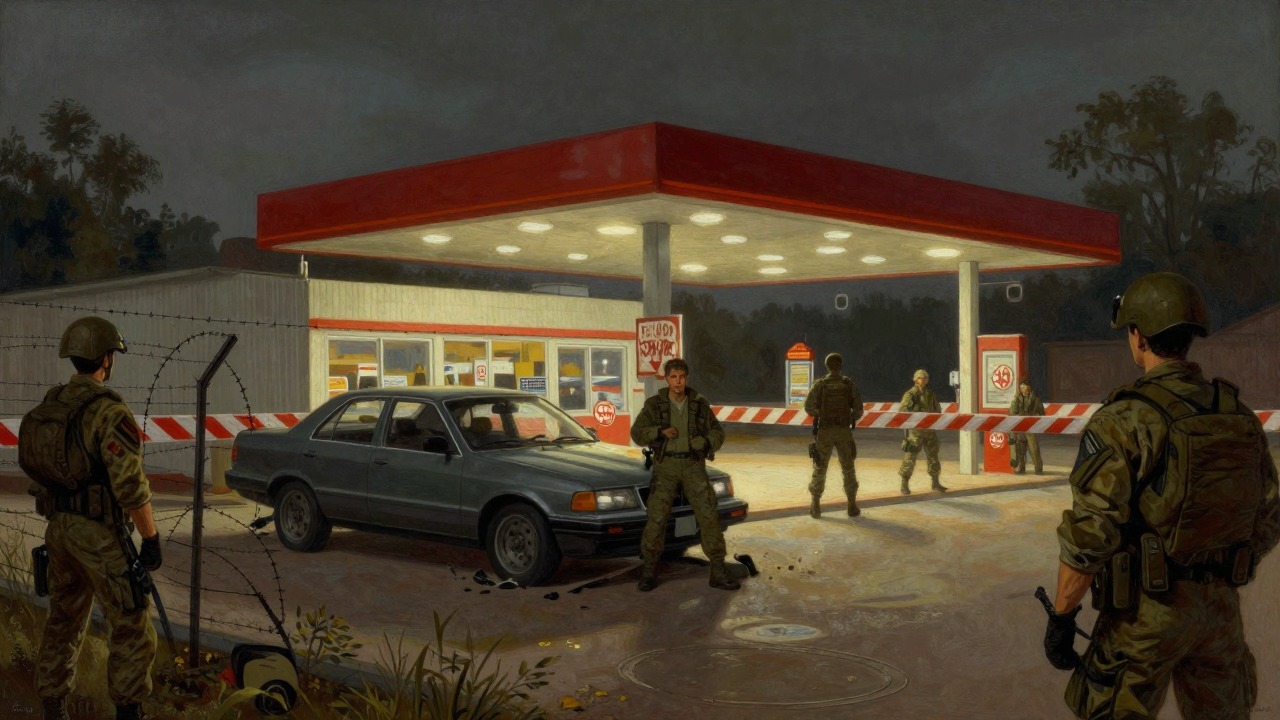
The Quarantine of Arnette was the U.S. military's first large-scale attempt to contain the superflu (Captain Trips) after Charles Campion crashed his car into Bill Hapscomb's Texaco station on June 16, 1990. The quarantine, enforced by roadblocks, barbed wire, and armed soldiers, was designed to prevent the disease from spreading beyond the small Texas town. It failed almost immediately because the disease had already escaped through asymptomatic carriers like State Trooper Joe Bob Brentwood, and the military's cover-up—including the murder of journalists in Sipe Springs—could not stop the pandemic. The quarantine marks the point where the government's response shifted from containment to suppression, and it reveals the structural weaknesses that allowed the superflu to become a global catastrophe.
Background and Establishment
Within hours of Campion's death, the military moved to seal off Arnette. The town's roads were blocked by olive-green trucks, and soldiers began stringing barbed wire around the perimeter, with plans to post sentries once the fencing was complete. The quarantine was ordered by the Atlanta Plague Center after pathologists confirmed that Campion's disease was a constantly shifting A-Prime flu with an estimated 99.4% communicability and excess mortality. The official cover story was that the outbreak was anthrax, a lie intended to prevent public panic. The quarantine was part of a broader pattern: similar cordons were established in Verona, Commerce City, and Polliston, Kansas, where the disease had spread so rapidly that the army was forced to intervene.
The Breach
The quarantine was doomed from the start. Joe Bob Brentwood, the Texas highway patrolman who had visited Hapscomb's station the morning after Campion's crash, was already infected when he returned to patrol. He passed the disease to Harry Trent, an insurance man he stopped for speeding, and Trent in turn infected dozens of people at Babe's Kwik-Eat café and beyond. The military's own data showed that Campion himself had been negative for over fifty hours before showing symptoms, meaning that asymptomatic carriers could spread the disease long before any quarantine could be effective. By the time the army sealed Arnette, the superflu had already begun its exponential spread across the country.
The Cover-Up and Its Consequences
As the disease escaped containment, the military's response shifted from quarantine to suppression. In Sipe Springs, Texas, a doctor made accurate guesses about the outbreak, and two reporters from a Houston daily linked it to the quarantined towns. General Starkey, commanding Project Blue, authorized a "Troy" protocol—a code for extreme covert countermeasures. Two young soldiers with M-3A rifles ambushed the reporters' car on US 36, killing the driver and a photographer, and then pursued and executed the photographer after he fled into a field. No report of disease or trouble in Sipe Springs was ever published. The cover-up extended to the national level: the President's speech on June 26 denied that the flu was fatal, called rumors of a government origin "a flat-out falsehood," and promised a vaccine that did not exist. The quarantine of Arnette thus became the first act in a larger drama of official deception that would continue until the collapse of all authority.
Significance
The Quarantine of Arnette is the event that reveals the structural failure of the old world's institutions. The military's attempt to contain the superflu was technically competent but strategically useless because the disease had already escaped through the very mechanisms of modern transportation and asymptomatic transmission that the quarantine was meant to control. The cover-up that followed—the murder of journalists, the suppression of news, the President's lies—demonstrates that the government's primary concern was not public health but the preservation of its own legitimacy. The quarantine thus serves as a microcosm of the larger collapse: the old order's tools were inadequate to the crisis, and its response was not protection but deception. The failure of the Arnette quarantine cleared the way for the pandemic to become a global extinction event, and it set the stage for the post-plague world in which new societies would have to be built from scratch.
Sipe Springs incident
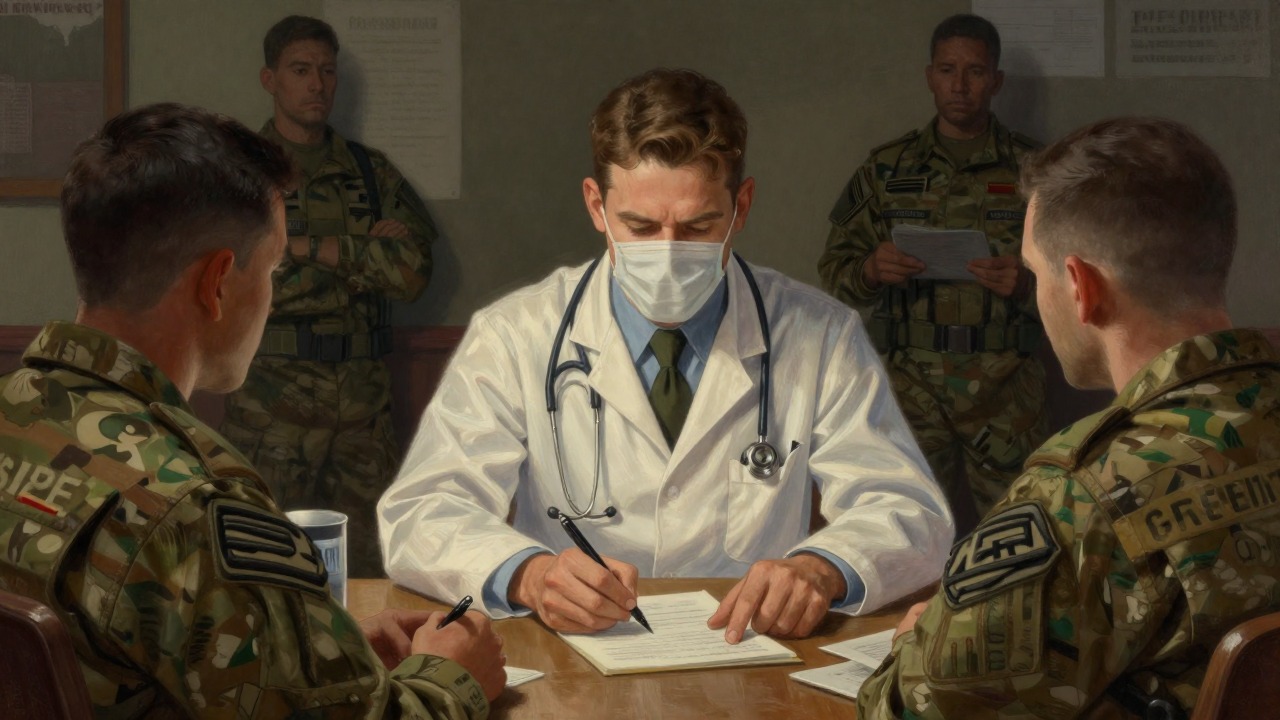
The Sipe Springs incident was a decisive moment in the early days of the superflu pandemic, marking the point at which the U.S. military command chose violent suppression over any pretense of public transparency. When a local doctor's accurate diagnosis and a pair of reporters' investigation threatened to expose the government's role in the catastrophe, General Starkey authorized a lethal cover-up, codenamed "Troy," that resulted in the cold-blooded execution of the journalists. The event crystallized the military's strategy of managing the truth through force, a policy that would unravel as the pandemic itself consumed the nation.
Background and the Threat of Exposure
The incident began when a doctor in Sipe Springs, Texas, made a series of correct deductions about the nature of the rapidly spreading disease. Two reporters for a large Houston daily newspaper, a stringer and a photographer, then linked what was happening in Sipe Springs with the already-quarantined towns of Arnette, Verona, Commerce City, and Polliston, Kansas. The computer at Project Blue had already identified twenty-five other towns in ten states where traces of the virus were beginning to appear, but the Sipe Springs situation was the first to threaten a public breach. The reporters' investigation was on the verge of seeing print, a development that would have bypassed the military's carefully constructed information blockade.
Starkey's Decision and the "Troy" Order
General Starkey, who had been running Project Blue on a cocktail of sedatives, received the urgent report from the field team in Sipe Springs. The situation was coded "Flowerpot" in the Contingency Book, a designation Starkey immediately recognized. As he listened to the report, he realized he had already made the decision, perhaps as long as twenty years before, to prioritize the military's institutional survival over any other consideration. He recalled a conversation from 1968, during the My Lai massacre fallout, where a fellow officer had argued that when a "regrettable incident" occurs involving the military, the first duty is to "cover their nakedness" out of love for the institution. Acting on this principle, Starkey unlocked a thin blue folder bound with red tape, the contents of which were marked for extreme covert countermeasures. He calmly gave the order "Troy" to the team in Sipe Springs, a command that was understood to mean the immediate and permanent silencing of the witnesses.
The Execution of the Journalists
The stringer and the photographer, driving a three-year-old Pontiac Bonneville at high speed toward Houston, were intercepted on US 36 by a nondescript Ford blocking the road. The stringer, a former army volunteer, got out of his car to confront the men he assumed were responsible for the near-accident. He had just enough time to identify their rifles as new M-3A's before they opened fire, killing him instantly. The photographer, who had been twisted over the back seat, watched in horror as the two young soldiers stepped over the stringer's body and advanced on him. He tried to flee, starting the car and driving on two flat tires, but the Ford pursued him. When he abandoned the car and ran into a field, he was caught on a barbed wire fence and shot dead. The soldiers, whose vehicle was listed in the Army Vehicles division at the Pentagon, then drove away, leaving no witnesses. No published report of the disease or any other trouble in Sipe Springs appeared that day.
Consequences and Significance
The Sipe Springs incident demonstrated the military's willingness to murder American civilians to maintain its cover story. It was a direct consequence of the 99.4% communicability and excess mortality rate of the A-Prime flu, a fact that Starkey knew made a vaccine almost impossible to create and the situation hopeless. The cover-up was a desperate attempt to control a narrative that was already unraveling, as the disease spread with a speed that no amount of censorship could match. The incident also foreshadowed the complete breakdown of civil order, as the military's own chain of command began to collapse under the strain of the pandemic, leading to events like the WBZ-TV coup and the Kent State massacre. The Sipe Springs incident stands as a stark example of the authoritarian response to a crisis, a response that would ultimately be rendered moot by the sheer scale of the catastrophe.
WBZ-TV coup
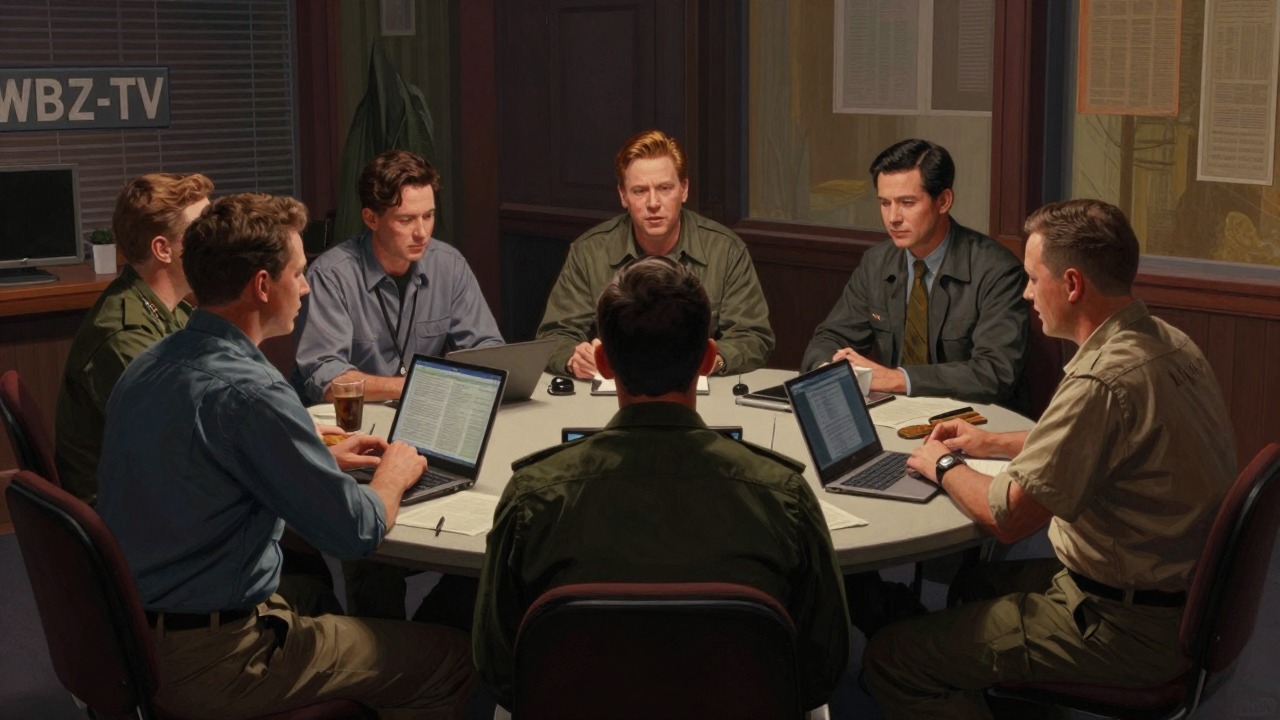
On the morning of June 26, 1990, a small rebellion erupted at WBZ-TV in Boston, a broadcast facility that had been under military control for the previous seven days. The coup was planned the night before by three newscasters and six technicians, all operating in Studio 6. Five of these men played poker regularly, and six of the nine were already ill with the superflu. They felt they had nothing to lose. They collected nearly a dozen handguns. Bob Palmer, who anchored the morning news, brought them upstairs inside a flight bag where he usually carried his notes, pencils, and several legal-sized notepads. The entire broadcast facility was cordoned off by what they had been told were National Guardsmen, but as Palmer had told George Dickerson the night before, they were the only over-fifty Guardsmen he had ever seen.
The Seizure of the Studio
At 9:01 A.M., just after Palmer had begun to read the soothing copy he had been handed ten minutes before by an army noncom, the coup took place. The nine of them effectively captured the television station. The soldiers, who hadn't expected any real trouble from a soft bunch of civilians accustomed to reporting tragedy at long distance, were taken completely by surprise and disarmed. Other station personnel joined the small rebellion, cleared the sixth floor quickly, and locked all the doors. The elevators were brought to six before the soldiers on the lobby level quite knew what was happening. Three soldiers tried to come up the east fire stairs, and a janitor named Charles Yorkin, armed with an army-issue carbine, fired a shot over their heads. It was the only shot fired.
The Uncensored Broadcast
Viewers in the WBZ-TV broadcast area saw Bob Palmer stop his newscast in the middle of a sentence, and heard him say, "Okay, right now!" There were scuffling sounds off-camera. When it was over, thousands of bemused viewers saw that Bob Palmer was now holding a snub-nosed pistol in his hand. A hoarse, off-mike voice yelled jubilantly: "We got em, Bob! We got the bastards! We got em all!" Palmer then faced into the camera again and declared that for the last seven days, the broadcast facility had been under guard by men purporting to be National Guardsmen. He stated that the news had been managed, that he had been given copy and forced to read it "almost literally with gun to my head," and that all of it regarding the superflu epidemic was "patently false." Lights began to flicker on the switchboard; within fifteen seconds every light was on. Palmer announced that they had film, taken clandestinely, and that they would run some of it. His face was replaced with shots of Boston General Hospital, where wards were crammed, patients lay on the floors, and nurses, many of them obviously sick themselves, wove in and out, some weeping hysterically. There were shots of guards standing on street corners with cradled rifles, and shots of buildings that had been broken into. Palmer then said quietly, "If you have children, ladies and gentlemen, we would advise that you ask them to leave the room." A grainy shot showed a truck backing down a pier over Boston Harbor, with a barge covered with canvas tarps below. Two soldiers in gas masks jumped down from the truck's cab, pulled back the canvas sheet covering the open rear end of the truck, and bodies began to cascade out onto the barge: women, old men, children, police, nurses. At some point during the film-clip it became clear that the soldiers were using pitchforks to get them out.
The Aftermath
Palmer went on broadcasting for two hours, his steadily hoarsening voice reading clippings and bulletins, interviewing other members of the crew. It went on until somebody on the ground floor realized that they didn't have to re-take the sixth floor to stop it. At 11:16, the WBZ transmitter was shut down permanently with twenty pounds of plastique. Palmer and the others on the sixth floor were summarily executed on charges of treason to their government, the United States of America.
Kent State massacre
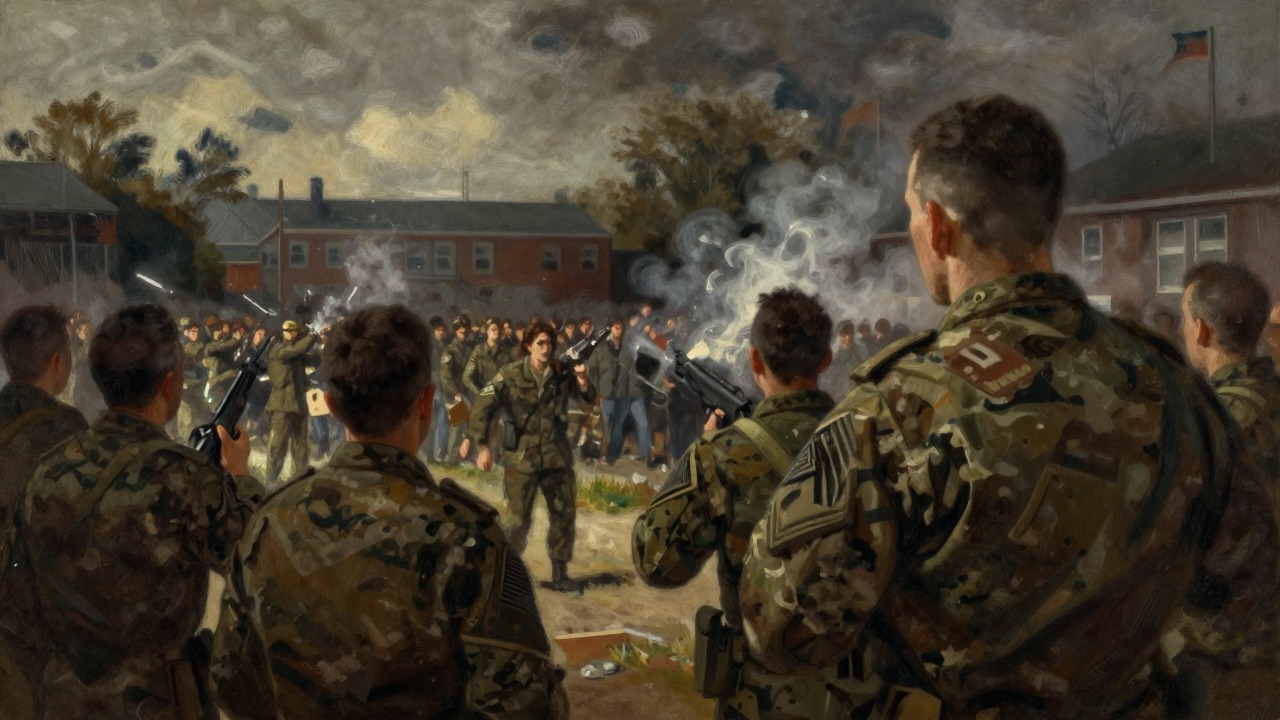
The Kent State massacre was a watershed moment in the disintegration of the United States during the superflu pandemic, demonstrating the government's willingness to use lethal force against its own citizens and accelerating the breakdown of military discipline and civil authority.
Background and Causes
By June 26, 1990, the superflu epidemic had thrown the nation into chaos. The government, under the direction of figures like Colonel Albert Philips, had imposed quarantines on campuses and cities, attempting to contain the spread of the disease. At Kent State University, approximately two thousand students—including summer session students, members of a journalism symposium, drama workshop attendees, and Future Farmers of America convention-goers—had been confined to campus since June 22. The students were restless, cooped up, and increasingly aware that the official story about the flu was a lie. Rumors of a government cover-up, fueled by broadcasts like the WBZ-TV coup in Boston and the Los Angeles Times extra edition, had spread, and the students were demanding the truth. The army's presence on campus, with troops in gas masks forming skirmish lines, created a volatile atmosphere.
What Happens
At 7:16 P.M. on June 26, police-band communications began to track the escalating confrontation. Campus Security Chief Richard Burleigh reported a group of about seventy students coming down the mall, followed by another group of over two hundred. Units were ordered to block the road with their cars but to offer no resistance. However, soldiers were already on the eastern side of the mall, wearing gas masks and forming a skirmish line. The students, carrying signs reading "SOLDIERS THROW DOWN YOUR GUNS" and "THE TRUTH THE WHOLE TRUTH AND NOTHING BUT THE TRUTH," marched toward the war memorial, where they turned toward the soldiers. Despite Burleigh's pleas to Colonel Philips to state his intentions, Philips declared his orders were to contain those on campus, and if they tried to break out of quarantine, they would be dealt with. When the students began throwing rocks, the soldiers opened fire with machine guns, without warning. The massacre was described by eyewitnesses as a "slaughter," with students cut in half by gunfire. The initial volley left an estimated seventy to eighty students lying on the grass. The violence then escalated as soldiers began shooting each other, and mortar rounds exploded. The turkey shoot continued, with the sounds of gunfire and screams filling the air.
Consequences and Aftermath
The Kent State massacre was not an isolated incident but part of a broader pattern of violent repression and societal collapse. The event directly echoed the 1970 Kent State shootings, a historical reference that underscored the government's willingness to repeat past atrocities. The massacre contributed to the rapid deterioration of the military's cohesion; soldiers began shooting their own officers, as seen in the Springfield, Missouri, incident where Sergeant Peters was assassinated by his own men. The violence spread, with similar massacres and executions occurring across the country, such as the WCSH-TV executions in Portland, Maine, where a black junta executed sixty-two white soldiers on live television. The government's cover-up, including the suppression of news and the use of martial law, unraveled as the truth about the superflu and the government's role in its creation became impossible to hide. The massacre at Kent State was a clear sign that the old order was not only failing but actively turning on its own people, paving the way for the complete breakdown of society and the emergence of new, often brutal, power structures in the aftermath.
Boulder Free Zone mass meeting
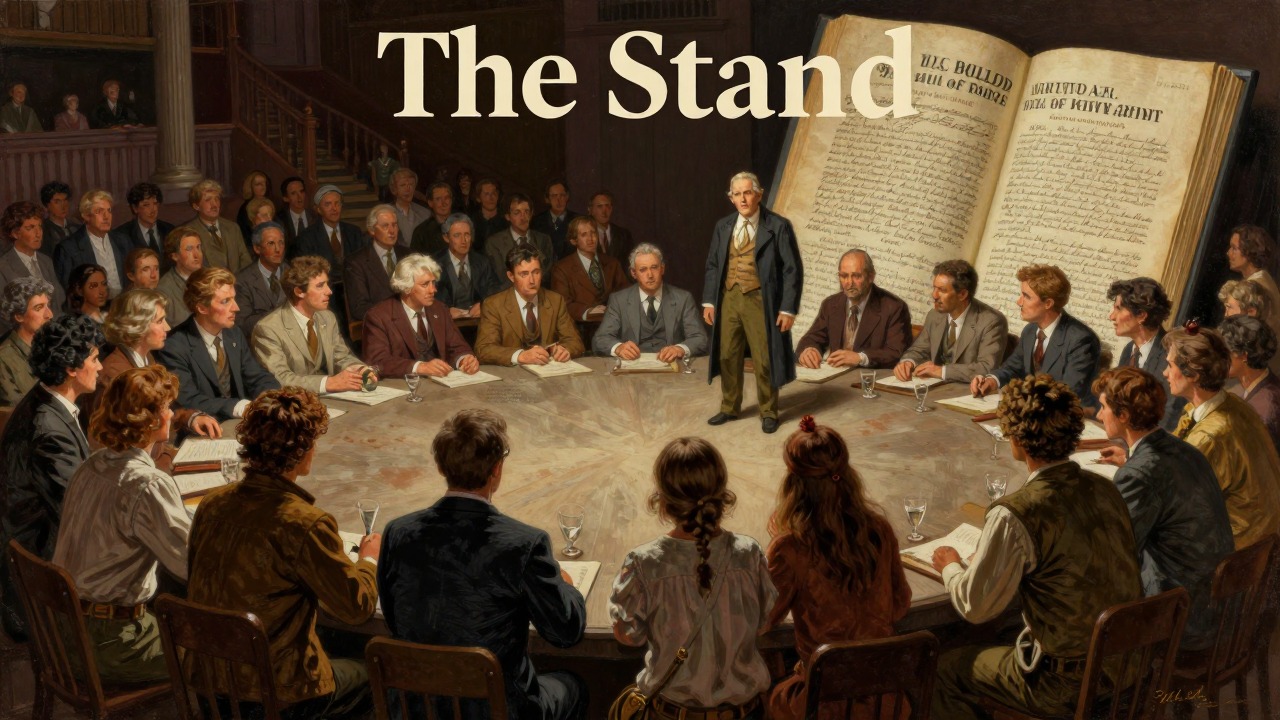
The Boulder Free Zone mass meeting, convened on the evening of August 18, 1990, at Chautauqua Auditorium, was the foundational political event of the post-plague community. It transformed a loose collection of survivors into a self-governing society, ratifying the U.S. Constitution and Bill of Rights, electing the ad hoc committee as the permanent Free Zone Committee, granting Mother Abagail veto power, and establishing the Burial, Power, and Search Committees. The meeting marked the community's transition from crisis management to organized self-government, setting the political framework that would guide the Free Zone through the coming winter and the confrontation with Randall Flagg.
Prelude and Atmosphere
The meeting was the culmination of weeks of planning by the ad hoc committee, which had printed and distributed mimeographed agendas. The auditorium was filled to capacity, with people sitting in the aisles and standing at the back. The atmosphere was one of subdued excitement and collective purpose, a sharp contrast to the fear and uncertainty that had marked the journey to Boulder. The meeting was called to order by Stuart Redman, who had been chosen as moderator. Before the formal business began, the assembly spontaneously rose to sing the National Anthem, a moment that moved many to tears and solidified the sense of shared identity and purpose.
Ratification of Founding Documents
The first two items on the agenda were the reading and ratification of the Constitution of the United States and the Bill of Rights. No one requested an actual reading, and both documents were approved by voice vote with overwhelming acclamation. This act was not merely symbolic; it was a deliberate choice to re-establish the legal and philosophical foundations of the old republic, providing a framework for law and governance in the new society. The ratification was followed by a thunderous round of applause, as the community affirmed its commitment to the principles of democracy and individual rights.
Election of the Permanent Committee
The third item was the nomination and election of a seven-member Free Zone Committee. Before the discussion could begin, Harold Lauder rose and moved that the existing ad hoc committee be accepted in toto as the permanent committee. The motion was seconded by multiple voices and passed by acclamation, with no opposition. This unexpected move, which had not been discussed in the committee's planning sessions, effectively short-circuited any potential for contested elections and ensured continuity of leadership. The permanent committee consisted of Stuart Redman, Frances Goldsmith, Glen Bateman, Nick Andros, Ralph Brentner, Susan Stern, and Larry Underwood.
Establishing Authority and Committees
The meeting then addressed the remaining agenda items. Mother Abagail was granted absolute veto power over any action proposed by the committee, a move that recognized her spiritual authority and the role of the shared dreams in uniting the community. The Burial Committee, the Power Committee, and the Search Committee were all approved, with Harold Lauder successfully amending the first two to increase their size proportionally with the population. Stuart Redman was later elected as the Free Zone Marshal, responsible for law and order. The meeting also established a one-year term for the committee and set the stage for future discussions on a representative government system.
Significance and Aftermath
The August 18 meeting was a watershed moment for the Boulder Free Zone. It provided a sense of stability and direction after months of chaos and uncertainty. The decisions made that night, particularly the ratification of the Constitution and the election of the committee, created a legitimate political structure that could make decisions, allocate resources, and prepare for the challenges ahead, including the coming winter and the threat from Randall Flagg's forces in the West. The meeting also demonstrated the community's collective will to rebuild a society based on democratic principles, a choice that would define its identity in the struggle to come.
Power Day
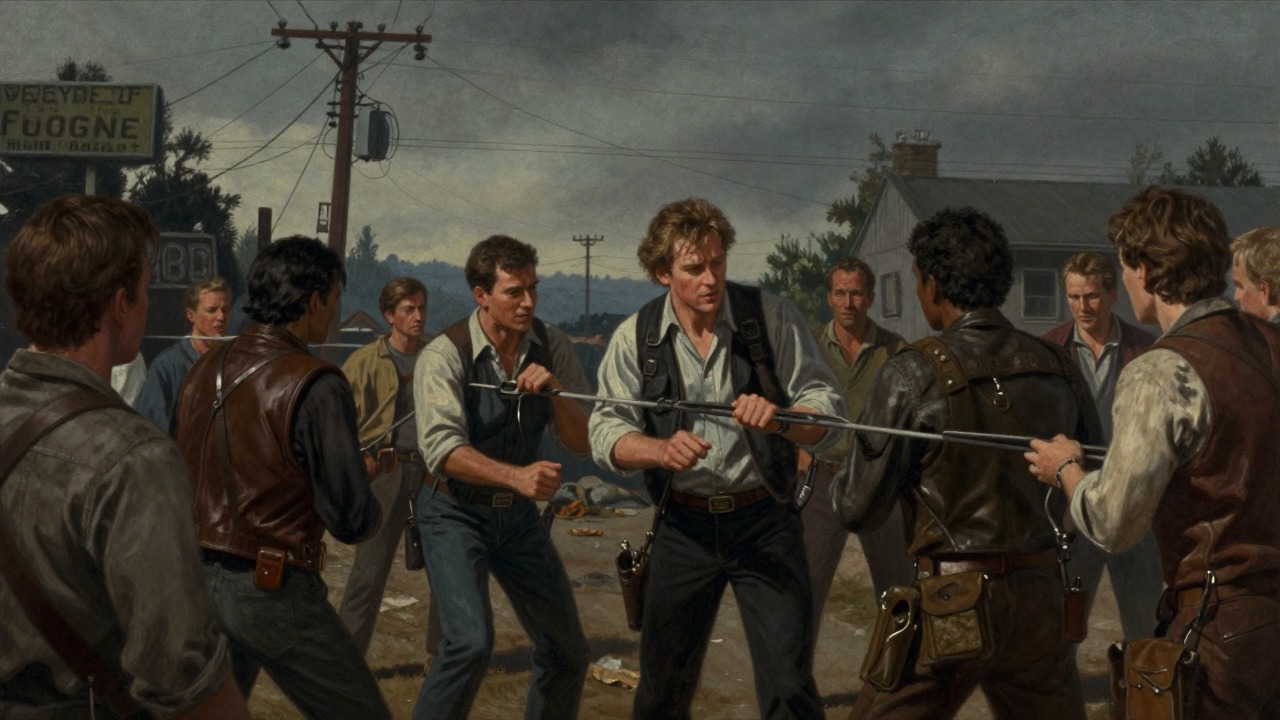
Power Day, September 5, 1990, was the day the Boulder Free Zone successfully restored electrical power after months of post-plague outage, marking a decisive turning point from survival toward reconstruction. The event, led by Brad Kitchner and the Power Committee, involved a controlled switch-on that caused a brief overload and a small fire but ultimately succeeded, transforming the community's morale and its practical capacity to face the coming winter.
Background and Preparation
After the superflu pandemic had killed over 99 percent of the population, Boulder's power grid had been dead since late June. The Free Zone's Power Committee, under the direction of Brad Kitchner, had spent weeks rewinding burned-out generator motors and repairing the power station's infrastructure. A test on September 1 had briefly brought electricity to North Boulder, but one generator overloaded and caught fire because too many household appliances had been left on when their owners died. That failure taught the committee a crucial lesson: before the full switch-on, every unoccupied building had to be cleared of electrical loads. Kitchner organized a "Turning-Off Crew" of a dozen volunteers to go through Boulder and shut off everything that had been left running—stove burners, electric blankets, televisions—to prevent a city-wide fire when the juice came back on. Ralph Brentner agreed to fill two fire-department tanker trucks at Boulder Reservoir and have them standing by at the power station. The public meeting on August 18 had approved the Power Committee's plan, and by September 4, Kitchner was confident enough to announce that the switch-on would happen at noon the next day.
What Happens
At noon on September 5, Brad Kitchner threw the switches at the power station. The air-raid siren atop the County Courthouse came on with a huge, braying whoop, scaring many people into the streets; some ran for their cellars until Kitchner found a fused switch and turned the siren off. There was an electrical fire on Willow Street, quickly put out by a volunteer crew. A manhole cover exploded at the Broadway-and-Walnut intersection, flew fifty feet, and landed on the roof of the Oz Toyshop. An auto-body shop on outer Pearl Street exploded, and Rich Moffat, sitting across the street with a bottle of Jack Daniel's, was killed instantly by a flying panel of corrugated steel siding. Despite these incidents, the power held. Fluorescents buzzed into life in the hospital where Fran Goldsmith was recovering from a whiplash injury; Stu Redman watched them flicker and catch, unable to look away until they had been glowing solidly for nearly three minutes. The lights came on all over Boulder, and the community celebrated.
Consequences and Aftermath
Power Day transformed the Free Zone's practical situation and its collective psychology. Refrigeration became possible, allowing fresh food to be stored. Electric lights replaced gas lamps, and the prospect of electric heat for the coming winter became real. The event also deepened the community's sense of identity and accomplishment: they had rebuilt something essential from the wreckage of the plague. For Fran Goldsmith, the return of the lights was bittersweet—she cried because Nick Andros, killed in the Free Zone Committee bombing three days earlier, was not alive to see it. Stu held her and found himself hating Harold Lauder, who had set the bomb, more than ever: "Harold had not just killed Nick and Sue; he had stolen their light." The successful restoration also strengthened the committee's standing, allowing them to turn the community's attention toward the longer-term threat from Randall Flagg in the West. Power Day was the first concrete proof that the Free Zone could not only survive but rebuild, and it gave people hope that they might face the coming winter—and whatever lay beyond it—with something like the old civilization's tools.
Free Zone Committee bombing
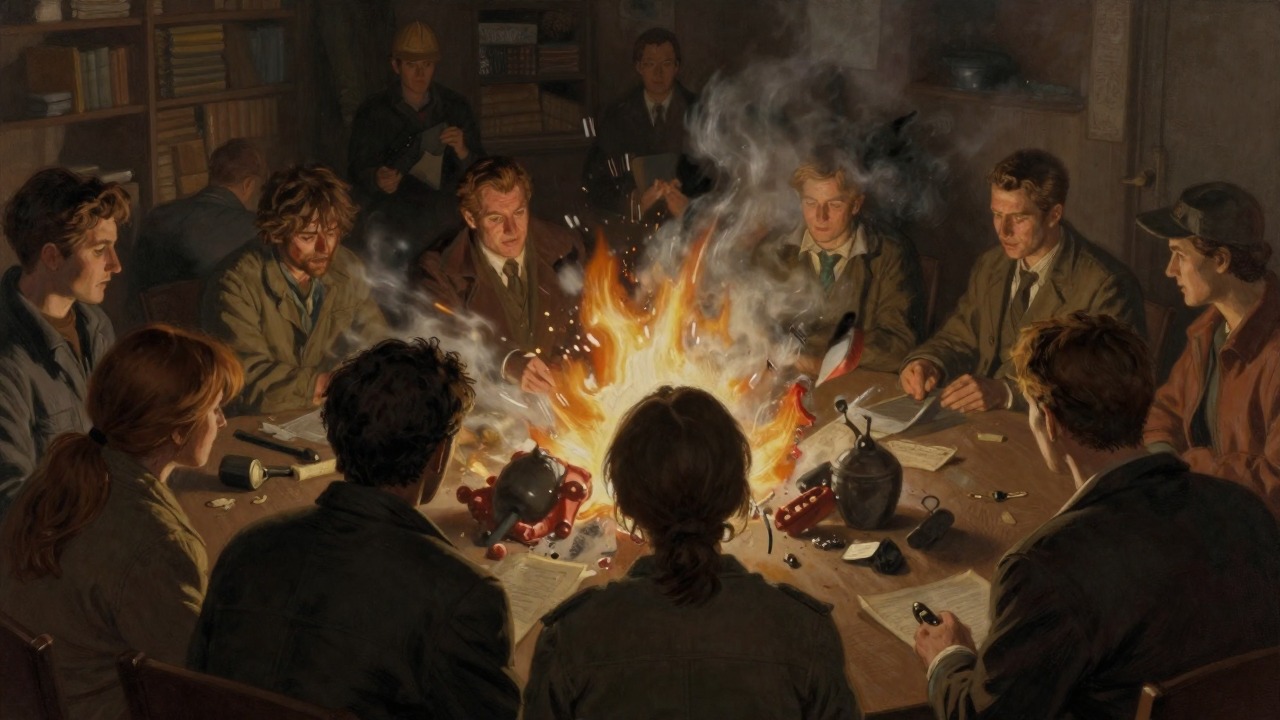
The Free Zone Committee bombing was the dark man Randall Flagg's most direct and devastating strike against the nascent Boulder Free Zone, an act of calculated terror that killed three committee members and four bystanders but ultimately failed to decapitate the community's leadership. Orchestrated by Harold Lauder and Nadine Cross, who had been seduced and manipulated by Flagg, the bombing was intended to wipe out the entire Free Zone Committee in a single blow, clearing the way for Flagg's eventual conquest. The explosion, triggered by a walkie-talkie detonator from a remote location, destroyed the house where the committee was meeting, but the committee's survival—and the subsequent unraveling of the plot—marked a turning point in the struggle between the Free Zone and the dark man.
Causes and Background
The bombing was the culmination of a long campaign by Randall Flagg to subvert the Boulder Free Zone from within. His primary instruments were Harold Lauder and Nadine Cross, both of whom had been alienated from the community and were susceptible to his influence. Harold, a brilliant but deeply resentful teenager, had been humiliated by his unrequited love for Frances Goldsmith and his exclusion from the Free Zone Committee. Nadine, a woman who had been psychically bound to Flagg for most of her life, was driven by a desperate, apocalyptic desire to fulfill her destiny as his bride. Flagg communicated with them through shared dreams and, in Nadine's case, through a planchette, guiding their actions and promising them power and belonging in his new order. The bomb itself was a sophisticated device: eight sticks of dynamite wired to a walkie-talkie handset, which Harold constructed in his basement using a diagram from a science fair book. Nadine planted the device in the closet of the house where the committee was to meet, ensuring it would be in the heart of the gathering.
What Happens
On the evening of September 2, 1990, the Free Zone Committee—Stuart Redman, Frances Goldsmith, Nick Andros, Glen Bateman, Ralph Brentner, Susan Stern, and Larry Underwood—gathered at Ralph Brentner's house for a meeting that included several subcommittee chairs. As the meeting progressed, a sudden commotion erupted outside: a large group of motorcyclists had arrived with the news that Mother Abagail had returned to Boulder, gravely ill. The committee members rushed out of the house to hear the news, leaving Nick Andros inside. Nick, sensing something was wrong, went to the closet where the bomb was hidden and pulled out the shoebox containing the device. At that moment, Harold Lauder, watching from Sunrise Amphitheater high above Boulder, spoke into his walkie-talkie: "This is Harold Emery Lauder speaking. I do this of my own free will." The bomb detonated, destroying the house in a massive explosion. Nick Andros, Susan Stern, and Chad Norris were killed instantly. Four others—Andrea Terminello, Dean Wykoff, Dale Pedersen, and Patsy Stone—also died. Twenty people were wounded, including Ralph Brentner, who lost two fingers, and Frances Goldsmith, who suffered a broken foot and a sprained back. The committee members who had been outside were thrown clear but were deeply shaken.
Consequences and Aftermath
The bombing failed in its primary objective: it did not kill the entire Free Zone Committee. Stu Redman, Fran Goldsmith, Glen Bateman, Ralph Brentner, and Larry Underwood all survived, though they were wounded and traumatized. The attack had the immediate effect of galvanizing the community against Flagg, but it also sowed deep fear and paranoia. Harold Lauder and Nadine Cross fled Boulder immediately after the bombing, heading west to join Flagg. Their escape was not clean: Harold's motorcycle crashed on a mountain road, breaking his leg, and Nadine abandoned him to die. Harold, dying and alone, wrote a final confession in his notebook, signing it "Hawk," before shooting himself. Nadine reached Las Vegas, where she was taken by Flagg, but her story ended in tragedy when she was thrown from a penthouse balcony. The bombing also had a profound impact on the surviving committee members. It hardened their resolve to confront Flagg, and it was a key factor in their decision to undertake the desperate walking quest to Las Vegas that Mother Abagail would later command. The event also exposed the vulnerability of the Free Zone to internal subversion and underscored the terrifying reach of the dark man's power.
Mother Abagail's withdrawal into the wilderness
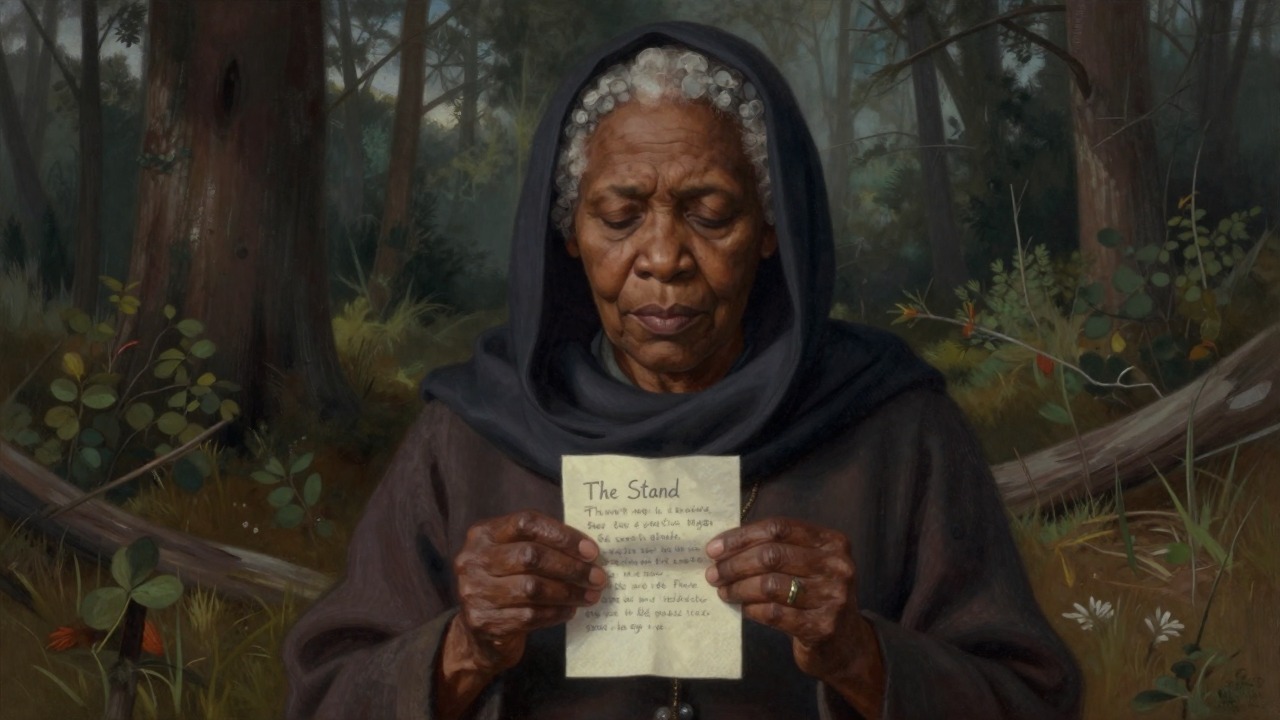
Mother Abagail Freemantle, the 108-year-old black woman whose prophetic dreams had drawn the survivors of the superflu pandemic to the Boulder Free Zone, abruptly disappeared from her home on the morning of August 14, 1990. She left behind a brief note written on a paper towel, confessing that she had "sinned and presumed to know the Mind of God" and that her sin had been "PRIDE." The note stated that God wanted her to "find my place in His work again" and that she would return "if it is God's will." Her departure was not a flight from responsibility but a deliberate act of spiritual penance, undertaken in the belief that she had failed in her role as God's vessel by taking personal credit for the divine power that had worked through her.
Causes and Background
The immediate cause of Mother Abagail's withdrawal was a profound crisis of conscience rooted in her own theology. She had long believed that God had preserved her for a specific purpose in the latter days, a conviction that had sustained her through the deaths of all her children and the loss of her family's Nebraska land. However, she came to recognize that her service had been tainted by pride—the "mother of sin" in her understanding. The specific trigger appears to have been a vision or dream in which a wolf, speaking with the voice of Randall Flagg, accused her of claiming for herself the power that belonged only to God: "Who brought water from the rock when we were thirsty?" the wolf asked, and she heard her own voice answer, "I did." This moment of self-accusation shattered her certainty and drove her to seek purification through wilderness exile, following the pattern of biblical prophets like Moses and Jesus who underwent testing in the desert.
The Departure and Its Immediate Aftermath
Glen Bateman discovered her absence when he visited her house around 8:30 A.M. to discuss the committee's plans. He found only the note on her pillow. The news spread rapidly through the Free Zone, causing consternation but, remarkably, not panic. Most residents interpreted her departure as a spiritual retreat rather than an abandonment, expressing confidence that she would return. The Free Zone Committee, however, was deeply troubled. Stu Redman argued passionately for organizing a search party, while Nick Andros and Glen Bateman counseled against forcing her return, recognizing that her withdrawal was a matter of conscience that could not be overridden by human authority. The committee ultimately compromised by placing Harold Lauder in charge of a Search Committee, though the effort was largely symbolic given the vast wilderness surrounding Boulder.
Consequences and Significance
Mother Abagail's absence had profound consequences for the Free Zone. It removed the community's unifying spiritual authority at a critical moment, forcing the committee to proceed with the August 18 mass meeting and the establishment of a secular government without her endorsement. Her disappearance also created a vacuum that Harold Lauder and Nadine Cross would later exploit, as the community's faith in divine protection was subtly undermined. More significantly, her withdrawal set the stage for her eventual return on the night of September 2, when she reappeared in a state of extreme physical depletion, having survived on roots and herbs, to deliver her final commission: that four men—Stu Redman, Larry Underwood, Ralph Brentner, and Glen Bateman—must walk to Las Vegas unarmed and without provisions to confront Randall Flagg. Her return, timed precisely to save the committee from Harold's bomb, demonstrated that her penance had been accepted and that her prophetic role was not yet complete. She died at sunrise on September 6, having fulfilled her final mission.
Mother Abagail's death and final commission
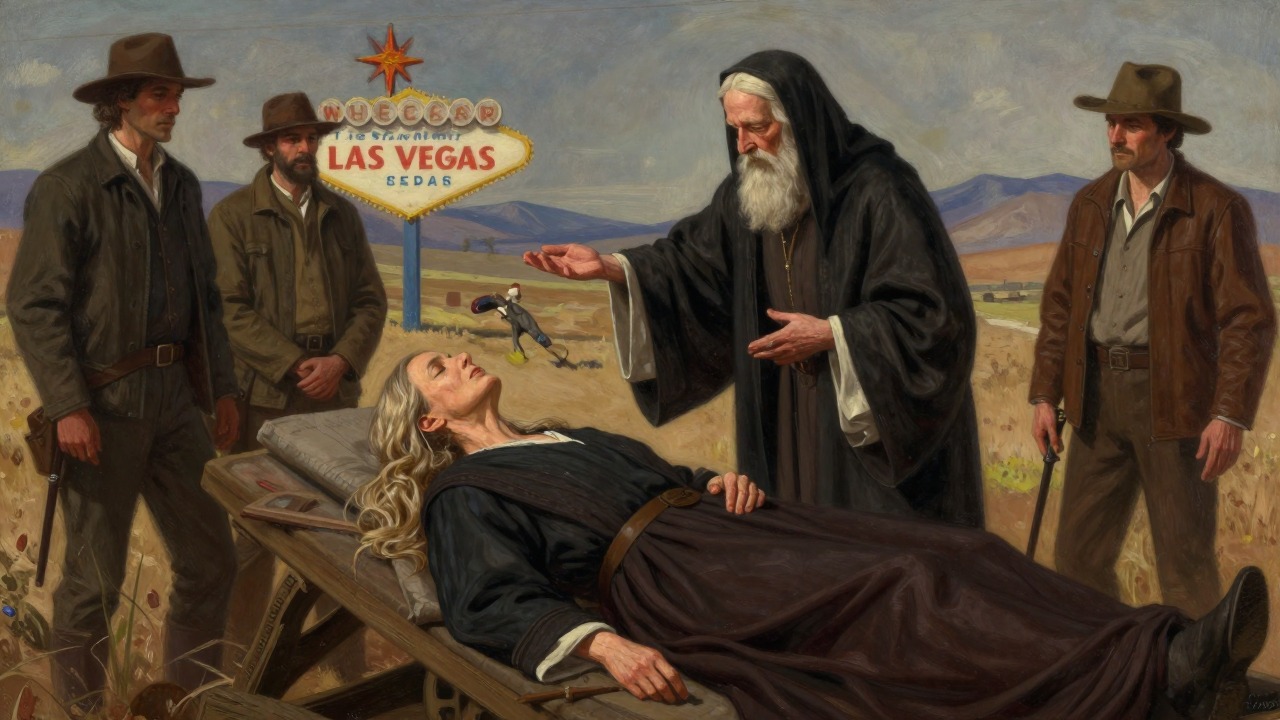
Mother Abagail's death and final commission is the climactic spiritual event of The Stand, in which the 108-year-old prophet, having returned from a self-imposed wilderness exile to die, delivers God's final instructions to the surviving Free Zone Committee members: they must walk west to Las Vegas unarmed and without provisions, trusting in divine protection to confront and destroy Randall Flagg. Her death transforms the committee's mission from political survival into a religious quest, and her final words—that one of the four will not reach the destination—cast a shadow of sacrificial doom over the journey that follows.
Return and Deathbed Scene
Mother Abagail had withdrawn into the wilderness after confessing the sin of pride, believing she had presumed to know the Mind of God. She returned to Boulder on the evening of September 2, 1990, led by Leo Rockway, just in time to save the Free Zone Committee from Harold Lauder's dynamite bomb—her reappearance drew them out of the house moments before the explosion. She collapsed immediately and was taken to Larry Underwood's house, where she lay in a coma for two days. George Richardson, the Zone's doctor, described her condition as extreme: she had lived on roots, herbs, and grass, her arm was covered with poison ivy, her legs with ulcerations, and she seemed to be consuming her own body for nourishment. Richardson stated flatly that he could do nothing for her and that her continued survival seemed a miracle. She woke in the early hours of September 5, knowing that Nick Andros and Susan Stern were dead and that Fran was in the hospital, though no one had told her.
The Final Commission
In the hour before dawn, Mother Abagail summoned the five surviving members of the Free Zone Committee—Stu Redman, Fran Goldsmith, Glen Bateman, Larry Underwood, and Ralph Brentner—along with Lucy Swann, to her bedside. She told them that God had not brought them together to form a committee or a community, but to send them further, on a quest: they must go west to Las Vegas and attempt to destroy Randall Flagg, whom she called the Dark Prince, the Man of Far Leagues. She specified that only the four men were to go; Fran was to stay behind. When Fran protested, Mother Abagail touched her wrist and instantly healed the whiplash and sprained back she had suffered in the explosion, saying, "God don't lay on no bribes, child. He just makes a sign and lets people take it as they will." She then commanded that the four men go on foot, taking no food, no water, and wearing only the clothes they stood up in, departing that very day. She prophesied that one of them would not reach their destination, but that the rest would be taken before Flagg himself.
The Nature of the Quest
Mother Abagail made clear that the outcome was not guaranteed. She told them she did not know if it was God's will for them to defeat Flagg or to ever see Boulder again. "Those things are not for me to see," she said. "But he is in Las Vegas, and you must go there, and it is there that you will make your stand." When Glen Bateman protested that they would be slaughtered by the first pickets they encountered, she reminded him of his own words, spoken weeks earlier: that only white magic could stop Flagg. She insisted that God's plan would not let them be killed by Flagg's least minion. When Larry Underwood asked bitterly if they had a choice, she replied, "There's always a choice. That's God's way, always will be. Your will is still free. Do as you will. There's no set of leg-irons on you. But… this is what God wants of you."
The Death and Its Aftermath
Mother Abagail died at sunrise on September 5, 1990, with a single final breath. Ralph Brentner crossed her hands on her thin bosom, weeping. Her death immediately precipitated the committee's decision: Stu Redman, despite Fran's desperate pleas, agreed to go, saying, "If we don't go, we'll die. She was right. If we wait, then spring comes. Then what? How are we going to stop him? We don't know. We don't have a clue." Glen Bateman, who had been the most skeptical, was the first to declare his commitment, saying, "White magic. That's all that's left." Larry Underwood and Ralph Brentner also agreed. The four men left Boulder at noon that same day, walking west toward Las Vegas, carrying nothing but the clothes on their backs. Fran, after a final picnic with Stu on Flagstaff Mountain, made him swear on Nick Andros's bloodstain that he would try to come back. The quest that Mother Abagail had ordained—a journey of faith, sacrifice, and uncertain outcome—had begun.
The walk to Las Vegas
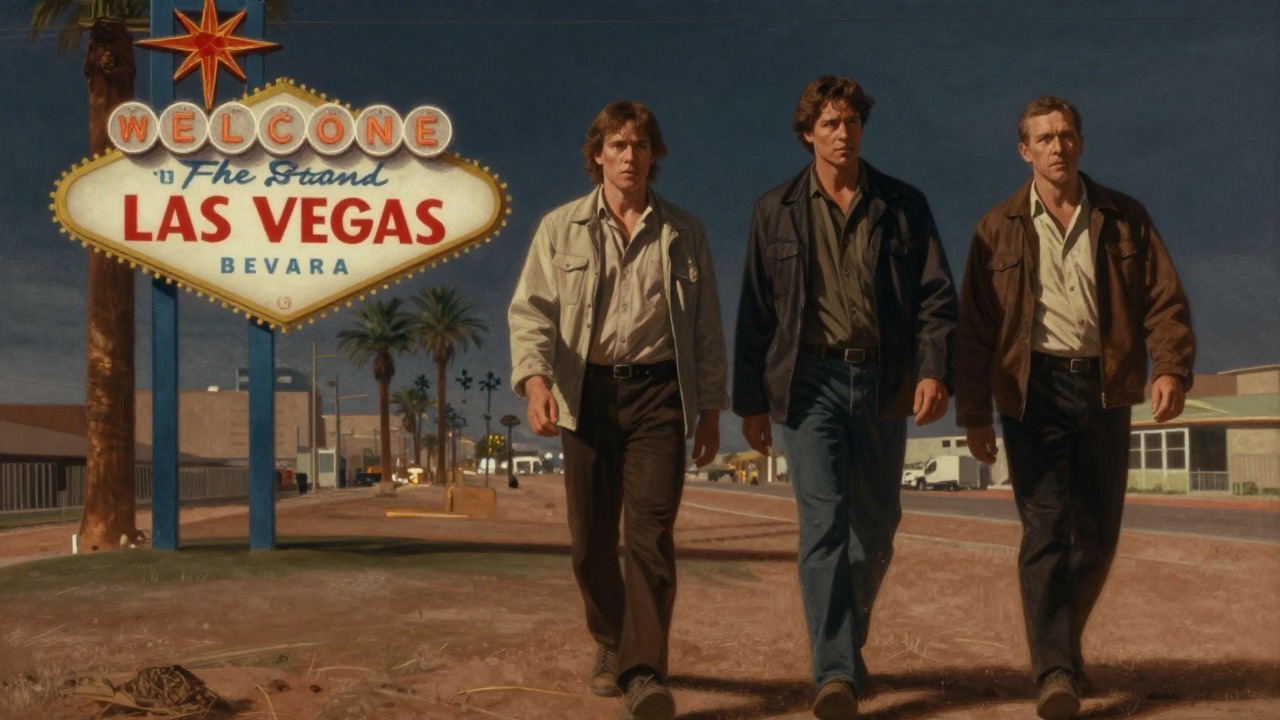
The walk to Las Vegas is the final, fateful journey undertaken by Stu Redman, Larry Underwood, Glen Bateman, and Ralph Brentner, who set out from Boulder on foot in early September 1990, following the dying commission of Mother Abagail. This quest, undertaken without food, water, or weapons, is the novel's climactic act of faith, a direct confrontation with the dark man Randall Flagg that ends not in a battle of arms but in a supernatural cataclysm, destroying Flagg's stronghold and leaving only Stu and Tom Cullen to return to Boulder.
Commission and Departure
Mother Abagail, on her deathbed after returning from her own wilderness ordeal, delivered the commission for the walk. She told the surviving members of the Free Zone Committee—Stu, Larry, Glen, and Ralph—that God had not brought them together to form a community, but to send them further, on a quest to destroy the dark man. She commanded them to go west, to Las Vegas, taking no food, no water, and no weapons, and to go on foot, in the clothes they stood up in. She prophesied that one of them would not reach their destination, but that the rest would be taken before Flagg. The four men accepted the commission, with Stu, as the leader, declaring, "I have to go." They left Boulder on September 6, 1990, walking southwest toward Golden, leaving behind a grieving Fran Goldsmith and Lucy Swann.
The Journey and Separation
The four pilgrims walked for over three weeks, covering over 360 miles across Colorado and Utah. They followed Mother Abagail's instructions to the letter, carrying nothing and foraging for food. The journey was a physical and spiritual ordeal, a process of emptying out the self. As Glen Bateman explained, they were like batteries being charged, stripping away the accessories of normal life to become vessels for a higher purpose. They experienced a growing sense of clarity and peace, a feeling of being "high" without drugs. The journey was marked by hardship, including a harrowing crossing of the Eisenhower Tunnel and the discovery of Harold Lauder's corpse. The group's unity was shattered when Stu Redman fell while climbing out of a washout on I-70 in Utah, breaking his leg badly. Unable to continue, he insisted the others go on without him, fulfilling Mother Abagail's prophecy that one would not reach the destination. Larry, Glen, and Ralph, after a painful argument, left Stu behind with a bottle of morphine-based pills, continuing west.
Capture and Execution
The remaining three pilgrims were captured by Flagg's men on September 28, just east of Las Vegas. They were taken to the city and imprisoned. Glen Bateman was executed the next day, shot by Lloyd Henreid after he mocked Flagg's power, laughing at the dark man and calling him "nothing." On the morning of September 30, Larry and Ralph were brought to the lawn of the MGM Grand Hotel, where Flagg had prepared a public execution. They were placed in steel cages on flatbed trucks, with chains and handcuffs attached to their wrists, intended to be pulled apart by cars. Flagg read a bill of charges against them, declaring them spies and saboteurs. As the execution was about to begin, Whitney Horgan, the cook, protested, but Flagg killed him with a ball of blue fire. The crowd was on the verge of panic.
The Cataclysm and Aftermath
At the moment of crisis, the Trashcan Man arrived, driving an electric cart carrying a nuclear warhead he had retrieved from a secret military base. He was in the final stages of radiation sickness, his body ravaged. He presented the bomb to Flagg as an offering, crying, "My life for you!" Flagg, terrified, ordered Lloyd to make him take it away. As the blue ball of fire Flagg had used to kill Whitney Horgan rushed toward the warhead, a blinding white light filled the world. The nuclear explosion destroyed Las Vegas, killing Flagg, Larry, Ralph, Lloyd, the Trashcan Man, and everyone else in the city. Stu, who had been left behind, witnessed the mushroom cloud from a distance. He was later found by Tom Cullen, who had escaped Las Vegas on the night of the full moon. Together, they survived the winter, and Stu returned to Boulder in January 1991, just after Fran gave birth to their son, Peter. The walk to Las Vegas ended not with a triumphant return, but with the destruction of the dark man's power and the beginning of a new, uncertain future.
Stu Redman's accident and separation
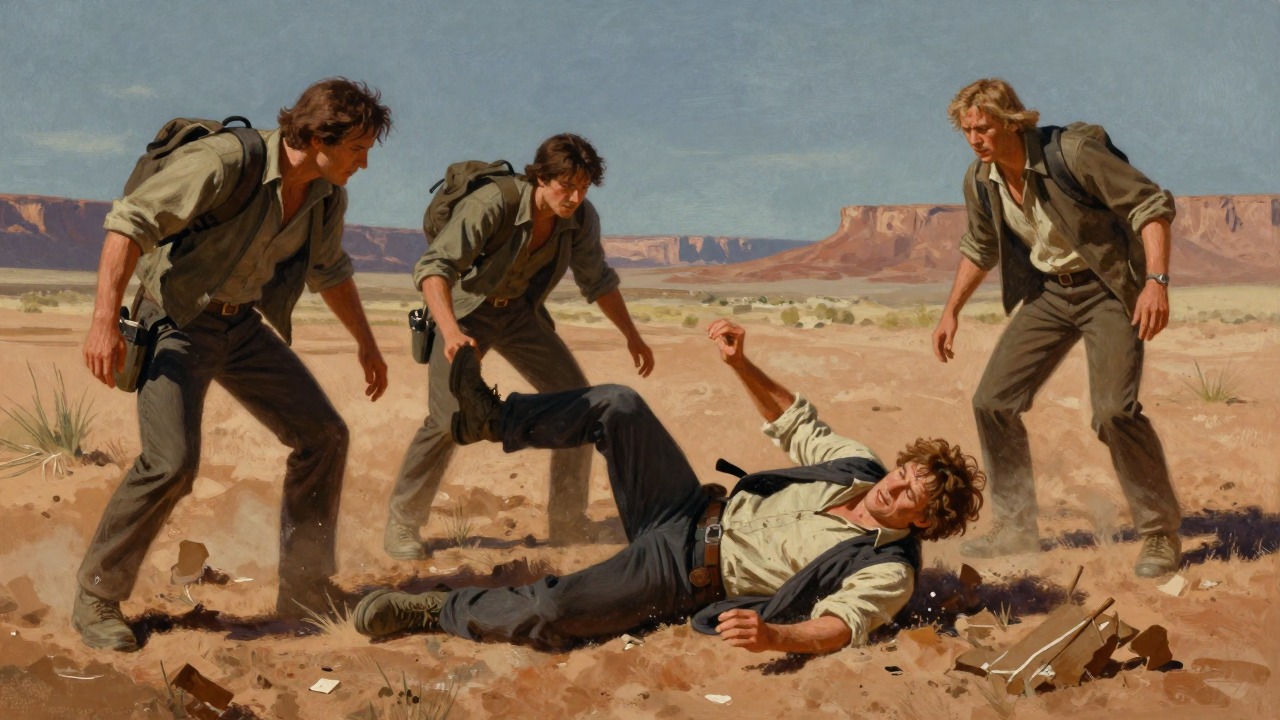
Stu Redman's accident and separation is the event that breaks the four-man quest party sent by Mother Abagail to confront Randall Flagg in Las Vegas, transforming a unified mission into a desperate struggle for survival on both sides of the Utah desert. The fall, which occurs on September 23, 1990, in a washout of Interstate 70 west of Green River, leaves Stu with a shattered leg and forces the others—Larry Underwood, Glen Bateman, and Ralph Brentner—to abandon him in accordance with the old woman's strict walking rules. This separation not only removes the group's natural leader but also creates the conditions for Stu's eventual rescue by Tom Cullen and for the final three pilgrims to reach Flagg's stronghold alone.
The Fall and the Fracture of the Quest
The accident happens when the four men attempt to cross a thirty-foot-deep gully carved by a flash flood. Stu climbs the western bank first, but near the top the loose sedimentary rock gives way. He slides, slams into a boulder, and hears his leg snap. A backward somersault breaks it again. He lands at the bottom, his leg now broken in at least two places, his knee sprung. The others help him splint the leg and give him a bottle of morphine-based pills that Glen Bateman has carried for his arthritis. Stu immediately understands what the pills are for: a way to end his life if the pain or exposure becomes unbearable. He tells the others, "I figure I'll be walking again in about three months," but the irony is bitter; he knows he cannot continue.
The Argument and the Decision to Leave
Larry Underwood, now the de facto leader by Mother Abagail's succession, refuses to leave Stu. He argues that they can carry him, that they can find a car, that the accident was "just loose dirt" and not part of any divine plan. Glen Bateman and Ralph Brentner, however, hold to the original terms of the quest: they must walk, carry nothing, and trust in God's providence. Glen tells Larry, "We made an agreement. We stood around Mother Abagail's deathbed and entered into it." Ralph adds, "It's a test." Stu himself casts the deciding vote: "I vote you go on." Larry, weeping, finally submits. Before leaving, Glen gives Stu the pill bottle and says, "Pull the plug if you have to, Stuart. Don't screw around." The three men climb the western bank and walk away without looking back. Stu watches them go, then lies alone in the gully with his broken leg and his morphine.
Kojak's Choice and the First Night
Kojak, Glen Bateman's dog who has followed the party from New Hampshire, does not leave with his master. Instead, he stays with Stu. That night, as Stu shivers in the cold and the wolves howl in the distance, Kojak brings him a rabbit. Stu skins and cooks it over a fire built with wood the dog fetches. They share the meat. The wolf howls continue, but Kojak growls back, and the pack does not approach. Stu sleeps with the dog curled beside him, drawing warmth from the animal's body. The first night ends with Stu alive, fed, and guarded—a small mercy that will prove decisive.
The Aftermath: Tom Cullen's Return and the Long Road Home
Stu survives in the washout for several days, his fever rising and his leg festering. He writes a farewell note to Frannie Goldsmith, attaches it to his key ring, and clips it to Kojak's collar, hoping the dog will find its way back to Boulder. But on the night of October 1, Tom Cullen—the retarded man who had been sent west as a spy and who has just escaped Las Vegas—stumbles upon the camp. Tom has been guided by dreams of Nick Andros, who told him where to find Stu. He carries Stu to Green River in a makeshift travois, finds penicillin in a drugstore (guided, he believes, by Nick's ghost), and nurses him through a near-fatal bout of pneumonia. The two spend the winter in Grand Junction, then cross the Rockies on snowmobiles, arriving in Boulder on January 9, 1991—just in time for Stu to meet his newborn son, Peter, who is fighting his own battle with the superflu.
Significance: The Quest's Broken Vessel
Stu's accident is the event that most directly tests the theological framework of the quest. If Mother Abagail's God truly guided the four men, why would He allow their leader to fall at the very threshold of the journey? The accident forces the remaining pilgrims to proceed without their strongest member, and it is they—Larry, Glen, and Ralph—who are captured, brought before Flagg, and ultimately die in the nuclear explosion that destroys Las Vegas. Stu, meanwhile, survives through a chain of improbable coincidences: Kojak's loyalty, Tom Cullen's return, the discovery of penicillin, and the long winter that gives his leg time to heal. The event thus embodies the novel's central ambiguity: is survival a matter of divine providence, blind luck, or the stubborn love of a dog and a simple man?
Las Vegas nuclear explosion
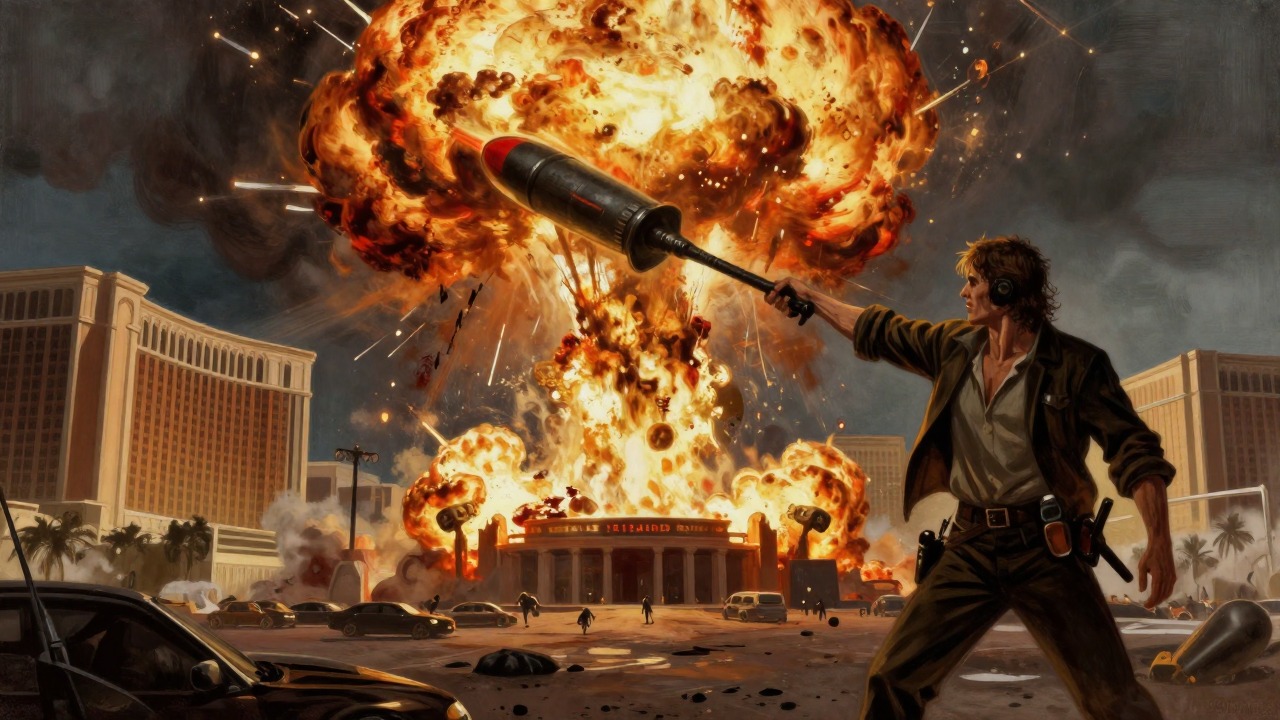
The Las Vegas nuclear explosion is the apocalyptic climax of Stephen King's The Stand, occurring on September 30, 1990, when the Trashcan Man, a deranged pyromaniac and weapons scavenger, delivers a stolen atomic warhead to Randall Flagg's stronghold at the MGM Grand Hotel. The detonation instantly vaporizes Flagg, his inner circle, and the entire Las Vegas community, while simultaneously killing the three Free Zone pilgrims—Larry Underwood, Ralph Brentner, and Glen Bateman—who had been captured and were about to be executed. The blast marks the definitive end of Flagg's nascent empire and the final, catastrophic act of the supernatural conflict that has driven the novel's plot.
Causes and Background
The explosion was the direct result of the Trashcan Man's obsessive quest for atonement. After sabotaging Flagg's helicopter fleet at Indian Springs, he fled into the Nevada desert, driven by a desire to redeem himself by finding a weapon of ultimate power. His peculiar ability to "sniff out" military hardware led him to a secret underground base within the Nellis Air Force Range, where he discovered a single atomic warhead, stamped A161410USAF. Despite suffering from acute radiation sickness—losing his hair, teeth, and nails, and developing open sores—he loaded the warhead onto an electric cart and drove it back to Las Vegas, arriving just as Flagg was about to execute Larry Underwood and Ralph Brentner by dismemberment.
What Happens
As the Trashcan Man's electric cart hummed onto the lawn of the MGM Grand, the gathered crowd panicked and fled. Flagg, momentarily frozen, attempted to destroy the warhead with a ball of blue electrical fire he had conjured from his finger. The ball of fire flew toward the cart, seeking the nuclear material. Lloyd Henreid, Flagg's lieutenant, cried out, "Oh shit we're all fucked!" and fell to his knees. A silent white light then filled the world, and "the righteous and unrighteous alike were consumed in that holy fire." The mushroom cloud rose on the horizon, visible to Stu Redman over a hundred miles away in Utah, who described it as "a clenched fist on the end of a long, dusty forearm." The blast instantly killed everyone in Las Vegas, including Flagg, Lloyd, the Trashcan Man, and the three Free Zone pilgrims who were chained in execution cages.
Consequences and Aftermath
The explosion had immediate and long-term consequences. It destroyed Flagg's power base, ending his plans for a spring offensive against the Boulder Free Zone. The nuclear blast also killed the three Free Zone pilgrims, leaving Stu Redman as the sole survivor of the four-man mission. The event was witnessed by Stu from a distance, who saw the mushroom cloud and understood that his friends were dead. The explosion also created a massive radioactive fallout cloud, which drifted westward over California. In the long term, the destruction of Las Vegas allowed the Boulder Free Zone to survive and grow, but it also left a lingering sense of unease, as the dark man's spirit was shown to have survived, washing up on a tropical beach and beginning his cycle of corruption anew. The event served as a final, terrible judgment, consuming both the evil of Flagg's regime and the sacrifice of the Free Zone's representatives.
Stu Redman and Tom Cullen's return to Boulder
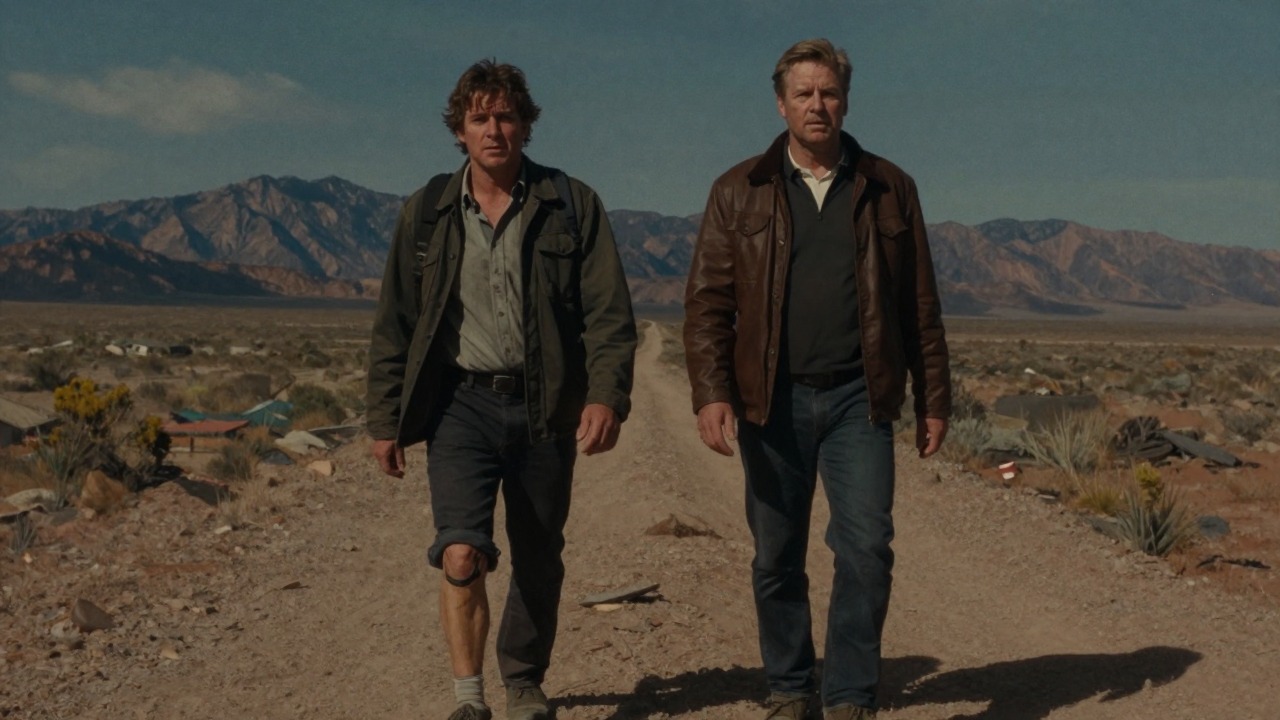
Stu Redman and Tom Cullen's return to Boulder is the final, arduous act of survival that closes the main narrative of The Stand. After the nuclear explosion that destroyed Las Vegas and seemingly ended Randall Flagg's reign, Stu, left behind with a broken leg and a severe case of the superflu, was rescued from certain death by Tom Cullen, who had been guided by dreams of Nick Andros. Together, with the loyal dog Kojak, they faced a brutal winter crossing of the Rocky Mountains, a journey that tested their endurance to the absolute limit and claimed the lives of their companions, Glen Bateman, Larry Underwood, and Ralph Brentner, who had gone on ahead to confront Flagg.
The Journey Through Winter
Stu's physical condition was dire. His leg had been improperly set, and he was wracked by a fever that nearly killed him. Tom, drawing on a strange, almost prophetic knowledge imparted in his dreams, found penicillin and other medicines in a Green River drugstore, and he forced Stu to walk despite his agony, a regimen that likely saved his life. They spent weeks snowed in at the Grand Junction Holiday Inn, where Stu built a movie projector to pass the time, and Tom created a papier-mâché landscape he called "Moonbase Alpha." When they finally decided to push on, they used a snowmobile, but it was lost in an avalanche near Avon. They continued on foot, often struggling through deep snow, their supplies dwindling. The wolves, still bearing the dark man's taint, howled in the night, a constant reminder of the evil they had left behind.
The Return and the News
On the night of January 8, 1991, Stu and Tom, exhausted and nearly frozen, stumbled into the outskirts of Boulder. They were challenged by a sentry, Billy Gehringer, who recognized them after Stu correctly identified a picture on the wall of his old apartment. The relief of their return was immediately tempered by devastating news. Billy told Stu that Fran had given birth to a son, Peter, but the baby had contracted the superflu. The Zone, which had celebrated the birth as a sign of hope, was now plunged into despair, believing that the plague would ultimately doom all future children. Stu, his heart heavy, limped to the hospital to see Fran.
Reunion and a Glimmer of Hope
In the hospital, Stu found Fran, who had resigned herself to the baby's death. Their reunion was a moment of profound, tearful relief. Soon after, doctors George Richardson and Dan Lathrop arrived with astonishing news. Peter, though sick, was not dying. Unlike all other victims of Captain Trips, his body was fighting back. The doctors theorized that Fran had passed on a partial immunity, and the baby was "wearing it out." He was not in the final, critical phase of the disease. This news transformed the mood of the entire Free Zone. Peter, the first child born to a survivor, became a symbol of a possible future, a fragile but real hope that humanity might not be doomed after all.
The Decision to Move On
Months later, in the spring, Stu and Fran decided to leave Boulder. Fran was homesick for Maine, and Stu felt a growing unease with the re-emerging structures of authority and organization in the Zone, which reminded him of the old world's mistakes. They planned to travel east, taking their son Peter with them. Before leaving, they stopped at Mother Abagail's abandoned house in Hemingford Home, Nebraska. There, sitting on her porch as the sun set, they watched Peter play in the yard. Stu reflected on the cyclical nature of history and the fragile hope that humanity might learn from its near-extinction. The novel ends with the image of the dark man, having survived the nuclear blast, washing up on a tropical beach, ready to begin his work of corruption anew, a stark reminder that the struggle between good and evil is eternal.
Cheery Oil tank explosion
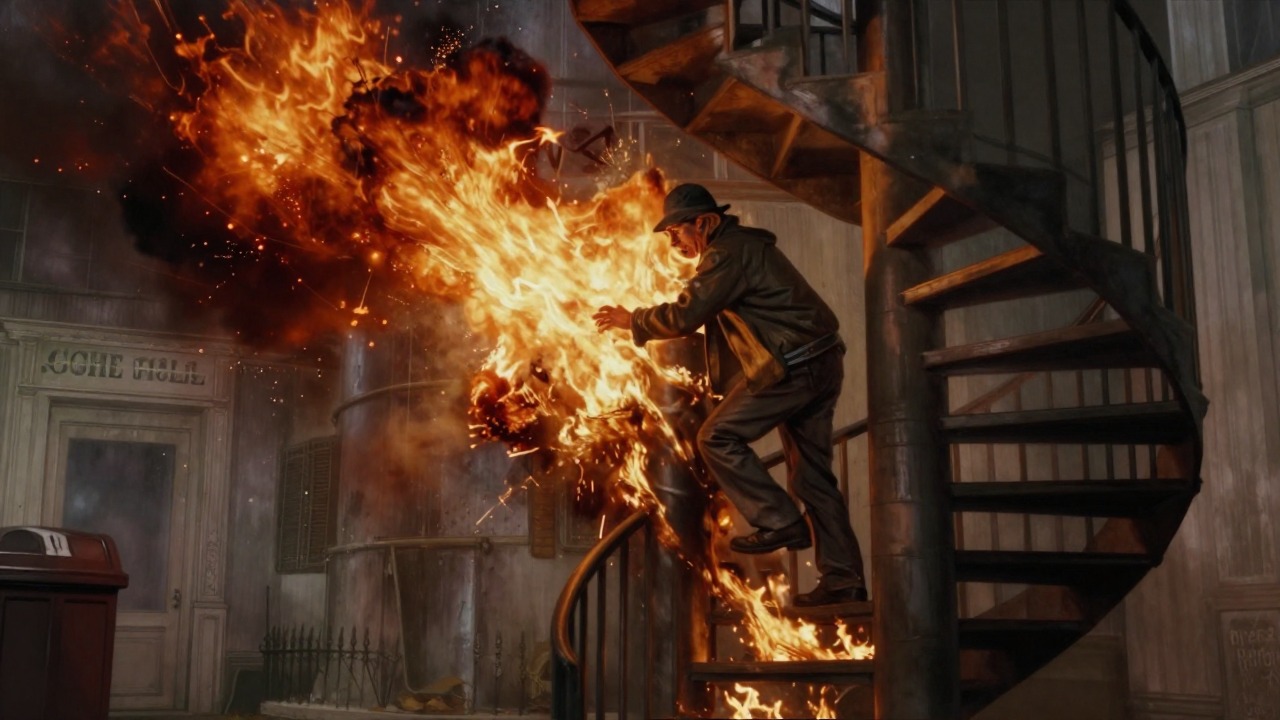
The Cheery Oil tank explosion is the event that completes the Trashcan Man's descent into madness and sets him on a westward path toward Randall Flagg. After the superflu has emptied his hometown, the Trashcan Man, driven by voices and a lifelong compulsion to burn, climbs the spiral stairs of the Cheery Oil Company's #1 storage tank, carrying a five-gallon can of gasoline and a toolkit. He uses his intuitive grasp of machinery to open the outflow pipe, then lights a match and drops it into a pool of spilled gasoline. The resulting explosion—a deafening KA-WHAP—rips through the tank, followed by a chain of secondary blasts that destroy the entire facility and ignite a firestorm that threatens to consume Powtanville and spread south toward Terre Haute. The Trashcan Man escapes by leaping from the tank, breaking his wrist, and running through the fallout zone as burning metal rains around him. This act of pyromania, born from a lifetime of abuse and institutionalization, severs his last ties to his former identity and propels him into the service of the dark man, who has been calling him through dreams. The explosion is not merely an act of destruction but a ritual of rebirth, transforming the Trashcan Man into a willing instrument of chaos, a "clot looking for a place to happen" who will later seek out weapons of mass destruction for Flagg's army.
Causes and Background
The Trashcan Man's history of fire-setting and mental illness directly precipitates the Cheery Oil explosion. From childhood, he has been known as a firebug, torching trashcans and mailboxes, and later burning down the Methodist Church in Powtanville. After years in reform school and prison, where he received electroshock treatments, he returns to find his hometown empty due to the superflu. The voices of his tormentors—Carley Yates and others—still haunt him, driving him to seek the ultimate fire. The Cheery Oil tanks, visible on the horizon, have long been an object of his obsessive fantasies; he has dreamed of their destruction as a single, thundering explosion that would reshape the daylight. The emptiness of the town removes all external restraint, and his internal compulsion, combined with his intuitive mechanical skill, leads him to the tanks.
What Happens
The Trashcan Man walks to the Cheery Oil facility, carrying a toolkit and a five-gallon can of gasoline. He climbs the spiral stairs to the top of the #1 storage tank, where he uses a wrench and hammer to open the outflow pipe, causing gasoline to trickle out. He drops the gas can over the side, then lights a match. After two matches are extinguished by the breeze, a third ignites the gasoline pool. The flames spread toward the machinery and the open pipe. As the vapor ignites, the outflow pipe is blown off, and the Trashcan Man vaults over the railing, breaking his wrist, and drops to the ground. He runs as the tank explodes with a KA-WHAP, followed by a second and third blast. The fireball creates a gigantic firetree, and burning metal falls around him. He escapes the fallout zone, his skin turning lobster red, and walks north toward Gary, grinning and chanting "Cibola."
Consequences and Aftermath
The Cheery Oil explosion destroys the tank farm and sets Powtanville ablaze, with the fire likely to spread south for months. The Trashcan Man's arm is badly burned, but the event cements his identity as a fire-worshipping servant of chaos. He later meets The Kid, a psychotic car enthusiast, and after a confrontation with wolves sent by Flagg, he is guided west to Las Vegas, where he becomes Flagg's weapons expert. The explosion marks the point of no return for the Trashcan Man, transforming him from a local outcast into a figure of apocalyptic significance, one who will later retrieve an atomic warhead for Flagg's army. The fire also symbolizes the destruction of the old world and the birth of a new, darker order, as the Trashcan Man's "Great Burning" aligns with Flagg's vision of a world consumed by fire.
Burrack store shootout
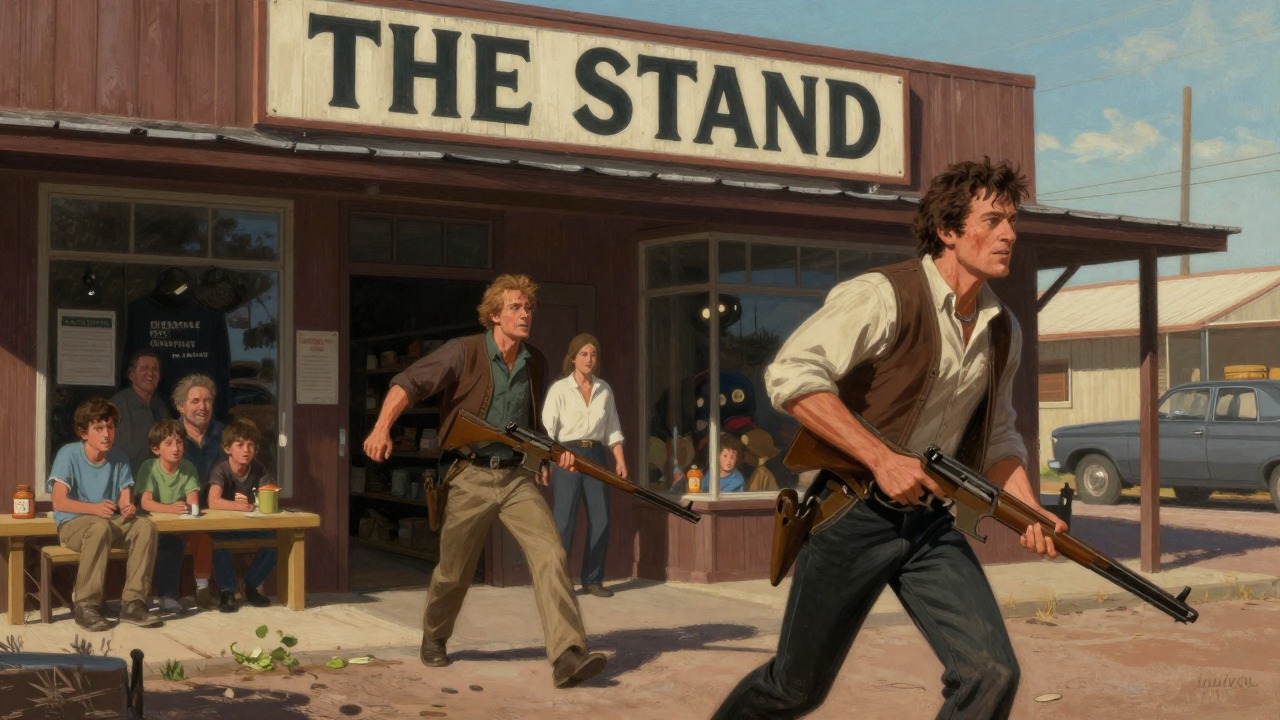
The Burrack store shootout marks the violent climax of the cross-country crime spree of Lloyd Henreid and Andrew "Poke" Freeman. Having already murdered the owner of a white Continental and his family, as well as the proprietor of a general store in Sheldon, Arizona, the pair are fleeing west in the stolen car, their nerves frayed by the dope and guns they carry. Their decision to stop in the small town of Burrack for gas and cash sets the stage for a sudden, brutal confrontation that ends their rampage and sends Lloyd to prison, where he will later be recruited by Randall Flagg.
The Robbery and the First Shots
Poke and Lloyd pull into a combination café, store, and gas station in Burrack. Poke arms himself with a .357 Magnum, while Lloyd carries a Schmeisser submachine gun. Inside, a tired-looking woman is shopping for spaghetti sauce, and a man in cowboy clothes is paying for cigarettes and Slim Jims at the counter. The proprietor, a freckled man in a gray shirt and a Shell cap, looks up as the screen door slaps shut. Lloyd fires a burst from the Schmeisser into the ceiling, shattering the hanging lightbulbs. He shouts, "Just hold still and nobody'll get hurt!" but Poke immediately contradicts him by shooting the woman looking at the sauces, killing her instantly. Poke yells, "Pokerized her, ole buddy! She'll never watch Jerry Falwell again! Whoop! Whoop!"
The Cowboy's Counterattack
The man in the cowboy clothes, who has been identified as Bill Markson, does not freeze. He plucks a .45 revolver from his belt and fires, hitting Poke in the left side of the face, vaporizing his cheek and teeth. Poke staggers backward, screaming, and falls onto the porch. Lloyd, stunned, fires the Schmeisser wildly, raking the store. The proprietor drops behind the counter. Lloyd's fire destroys a gumball machine, bottles, and a calendar, but he also puts three bullets into the cowboy, killing him. Lloyd, panicked, continues firing until the Schmeisser is empty. The store is filled with the smell of gunpowder and the sight of the dead woman and the dead cowboy.
The Storekeeper's Final Stand
Poke, horribly wounded, staggers back inside, demanding to kill the cowboy. He puts a foot on the cowboy's body and prepares to empty his .357 into the man's head. At that moment, the proprietor, who had hidden behind the counter, pops back up with a double-barreled shotgun. Poke looks up just in time to receive both barrels in the face, killing him instantly. Lloyd, seeing his partner dead and the situation hopeless, decides to flee. He runs out of the store, but an Arizona State Police cruiser has just pulled into the yard. A trooper orders him to halt. Lloyd tries to run for the Continental, but the trooper fires a warning shot, and Lloyd surrenders. The proprietor comes out onto the porch, still clutching his shotgun, and yells that he wants to shoot Lloyd too, but the troopers calm him down. Lloyd is handcuffed and taken into custody, ending the spree that had made him and Poke the subjects of a massive manhunt.
Consequences and Significance
The Burrack store shootout directly leads to Lloyd Henreid's imprisonment in the Apache County Jail. While awaiting trial under the swift "Markham vs. South Carolina" guidelines, which could have led to his execution within weeks, the superflu epidemic sweeps through the prison. The guards and staff die or desert, leaving Lloyd to starve in his cell. This desperate situation makes him receptive to the rescue and offer of power from Randall Flagg, who frees him and makes him his right-hand man. The shootout thus serves as the pivotal event that transforms Lloyd from a small-time criminal into a key lieutenant in the dark man's emerging empire in the West. The violence of the encounter also foreshadows the brutal, lawless nature of the world that Flagg will come to rule.
Event 1
Event 2
Event 3
Event 4
Event 5
Event 6
Event 7
Event 8
Event 9
Event 10
Event 11
Event 12
Event 13
Event 14
Event 15
Event 16
Event 17
Event 18
